Grand National Forecast and Tricast Bets: How They Work and What They Pay
 Available in US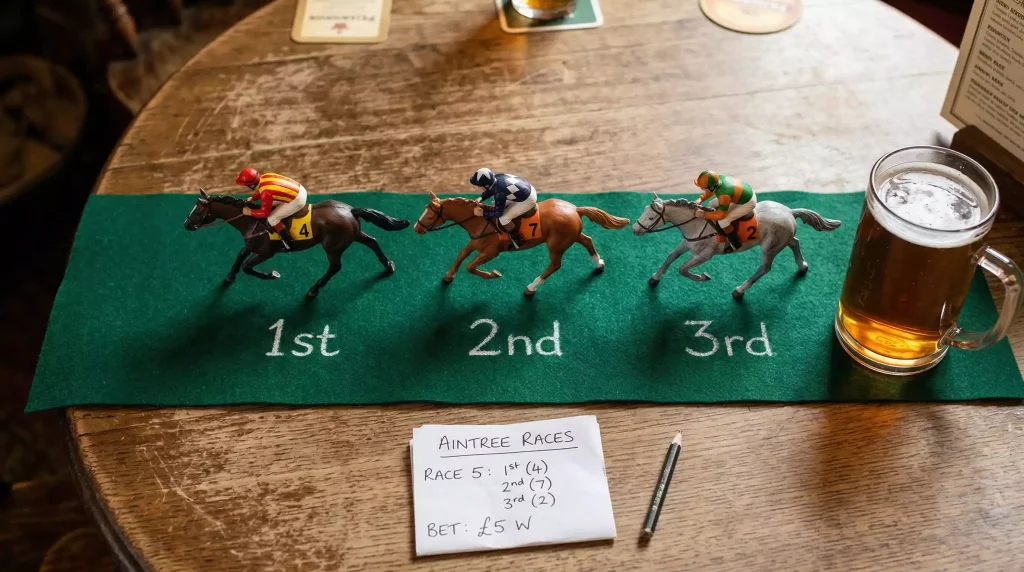
Most Grand National punters stick with the familiar: a win bet, an each-way flutter, maybe a few quid on a long shot. But for those willing to take on a bigger challenge — and chase a bigger payout — forecast and tricast bets offer something altogether more ambitious. Instead of simply picking a winner, you are predicting the order of finish. Get it right, and the returns can be extraordinary. Get it wrong, and you lose your stake just like any other bet. The appeal lies in the payoff, and in a race as chaotic as the Grand National, predicting the order is as close to catching lightning in a bottle as betting gets.
This guide explains how straight forecasts, reverse forecasts, tricasts and their combination variants work, with real Grand National context to show why the odds — and the potential rewards — are so large.
How any return is worked out is in the payout guide.
Straight and Reverse Forecast: Predicting First and Second
A straight forecast requires you to name the first and second-place finishers in the correct order. You are not just picking a winner — you are also identifying which horse will run second, and you need to get both right, in exactly that sequence.
The mechanics are simple. You select Horse A to finish first and Horse B to finish second. If Horse A wins and Horse B is the runner-up, your bet pays out. If they finish in the opposite order, or if either horse finishes outside the top two, you lose. There is no place payout, no consolation — it is all or nothing on the exact finishing order.
The payout on a forecast is not set at fixed odds. Instead, it is calculated using the Computer Straight Forecast, a formula that takes into account the starting prices of both horses. The less likely the combination, the higher the payout. In a field of 34 Grand National runners, the number of possible first-and-second combinations is enormous, which is why forecast dividends on the National can be genuinely eye-watering.
Consider the 2026 Grand National. Nick Rockett won at 33/1, an outsider by any measure, with the Mullins-trained runners dominating the finish. A straight forecast linking Nick Rockett with another long-priced finisher would have returned a substantial dividend — far beyond what a simple win bet at 33/1 would have paid. That is the appeal of predicting the order: in a race where outsiders regularly fill the frame, the forecast multiplies the unpredictability into a massive price.
A reverse forecast is a less demanding variation. Instead of specifying which horse finishes first and which finishes second, you simply name two horses to fill the first two places in either order. It costs twice as much as a straight forecast — because it is effectively two straight forecasts in one — but it removes the need to predict the precise sequence. In a race like the Grand National, where the margin between first and second can be a nose, the reverse forecast is a sensible hedge if you fancy two horses but cannot confidently separate them.
Tricast Bets: Picking the First Three Home
If a forecast is ambitious, a tricast is borderline audacious. A straight tricast requires you to name the first, second and third-place finishers in the exact order. Get all three right, in the right sequence, and the payout is colossal. The mathematical probability of doing so in a 34-runner handicap is vanishingly small, which is exactly why the dividends are so large.
Like forecasts, tricast payouts are calculated by formula rather than fixed odds, based on the starting prices of all three horses. The more unexpected the combination, the bigger the return. A tricast involving three well-fancied runners might pay a few hundred pounds from a small stake. A tricast involving three outsiders could pay thousands.
The Grand National is one of the few races where tricasts are widely offered, precisely because the field size justifies the bet. With 34 runners, the number of possible first-three combinations runs into the tens of thousands — making it almost impossible to predict, but extraordinarily rewarding when it comes off. In the 2026 Grand National, 21 of the 32 starters completed the course, a decent completion rate that still left plenty of scope for surprise results in the minor placings.
A combination tricast relaxes the rules further. Instead of naming the exact 1-2-3 order, you select three horses to fill the first three places in any order. This costs six times the unit stake — because there are six possible orderings of three horses — but it removes the need to predict the precise finishing sequence. For those who fancy a group of horses without wanting to commit to an exact arrangement, the combination tricast is the way to go.
The Tote offers its own versions of these bets: the Exacta (equivalent to a forecast) and the Trifecta (equivalent to a tricast). Tote pools work differently from bookmaker forecasts — the dividend is determined by the size of the pool and the number of winning tickets — but the principle is the same: predict the finish order, and collect a dividend that reflects the difficulty of doing so.
The wider context is set out in our Grand National betting guide.
Potential Payouts: Why Forecast and Tricast Odds Are Huge
The reason forecast and tricast dividends are so large on the Grand National comes down to field size and unpredictability. In a 34-runner race, the number of possible straight forecast combinations is 34 times 33 — that is 1,122 distinct outcomes. For a straight tricast, it is 34 times 33 times 32 — a staggering 35,904 possible finishing orders for the first three. When the pool of possible outcomes is that vast, and most punters cluster their selections around a handful of fancied runners, the right combination of outsiders can produce dividends measured in thousands of pounds per pound staked.
To put it in perspective: a £1 straight forecast on two 20/1 shots finishing first and second could easily return north of £500. A £1 tricast involving three horses at 25/1, 33/1 and 40/1 could return several thousand. These are not hypothetical numbers — Grand National forecasts and tricasts routinely produce dividends that dwarf the win and place payouts.
The downside, of course, is that the probability of landing the bet is correspondingly low. Most forecast and tricast bets on the Grand National lose. The maths is against you, and no amount of form reading can reliably predict which horse will finish second or third in a four-mile steeplechase over 30 fences. That said, if you are already confident in one horse, adding a forecast or tricast alongside your each-way bet is a low-cost way to chase a life-changing return. Treat it as a lottery ticket with a racing twist — the odds are long, but the Grand National has a habit of producing results that no one saw coming.
One practical note: not all bookmakers offer forecasts and tricasts on the Grand National, particularly in their online markets. Check before race day whether your preferred bookmaker includes these bet types for the race, and whether there are any minimum stake requirements. The Tote Exacta and Trifecta are always available at the course and through the Tote website, so those are a reliable fallback if your bookmaker does not cover it.
