
Exchange Betting on the Grand National: Back, Lay and Trade on the Exchanges
 Available in US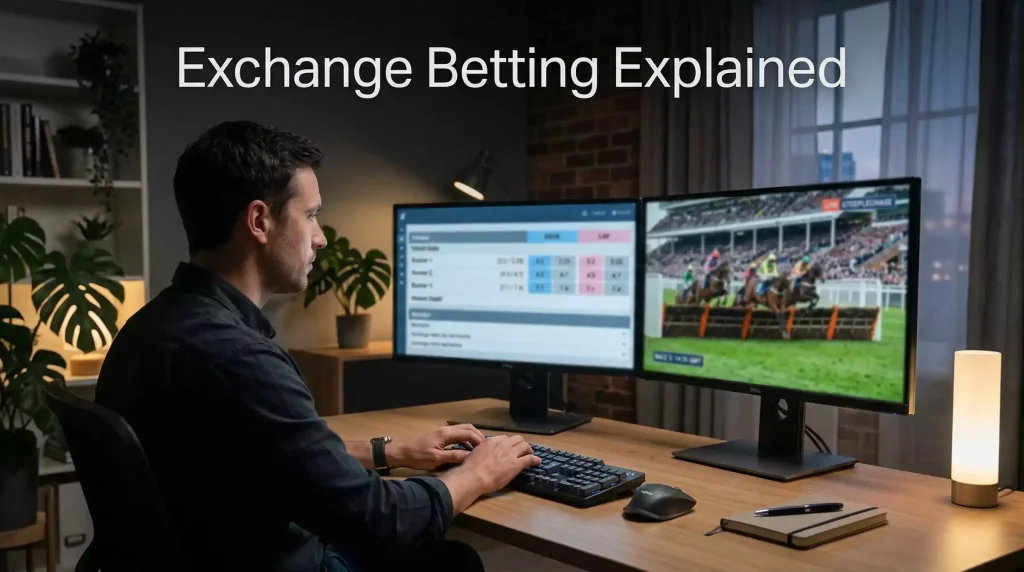
Most people who bet on the Grand National do so through a traditional bookmaker — pick a horse, take the price, hope for the best. But there is another way. Betting exchanges flip the model entirely. Instead of betting against a bookmaker, you bet against other punters. You can back a horse to win, just like at any bookie — but you can also lay a horse, effectively betting that it will not win. That ability to take either side of a bet is what makes exchanges unique, and it opens up a range of strategies that simply are not possible with a conventional bookmaker. On the exchange, you can be the bookmaker.
This guide explains how betting exchanges work, what the difference between backing and laying actually means, and when it makes sense to use an exchange rather than a traditional bookmaker for your Grand National bet.
Free-bet arbitrage builds on it: matched betting.
How a Betting Exchange Works: The Basics
A betting exchange is a platform that matches two people who want to take opposite sides of the same bet. One person backs a horse to win; another person lays that horse (bets it will not win). The exchange facilitates the match and takes a small commission — typically between 2% and 5% — on the winning side’s profit. The exchange itself has no stake in the outcome of the race; it earns its money from the commission, regardless of which horse wins.
The two major exchanges operating in the UK are Betfair Exchange and Smarkets. Betfair is by far the larger of the two, with deeper liquidity — meaning more money available to match your bet at any given price — and a wider range of markets. Smarkets offers lower commission rates (typically 2% compared to Betfair’s standard 5%, though Betfair offers reduced rates for high-volume users), which can make it attractive for regular traders.
The prices on an exchange are set by the users, not by a bookmaker’s trading team. If you want to back a horse at 10/1 and someone else is willing to lay it at that price, the bet is matched. If no one is willing to lay at your price, your bet sits in the queue until someone takes it or you cancel. This is why exchange markets can be more volatile than bookmaker markets: prices are driven by supply and demand in real time, and they can move sharply in the minutes before a race.
The UK’s overall gambling industry generated a gross gambling yield of £16.8 billion in the financial year 2026-25, with the online segment growing by more than £900 million. Exchanges represent a growing slice of that online market. The Grand National, as the single biggest betting event of the year, generates some of the deepest exchange liquidity in the racing calendar — meaning there is more money available to match bets, tighter spreads between back and lay prices, and more opportunities for punters who know how to use the platform.
One important distinction: on an exchange, you are not offered “best odds guaranteed” or promotional free bets in the way a traditional bookmaker might offer them. Exchange prices reflect the raw market — what other punters are willing to back and lay at — without the promotional sweeteners. For many experienced bettors, that raw market is a feature, not a drawback: the odds are often better than bookmaker prices, particularly on fancied runners in high-profile races.
Back vs Lay: What Each Side of the Trade Means
The back side of an exchange bet works exactly like a traditional bookmaker bet. You select a horse, choose your stake, and if the horse wins, you collect your profit. The only difference is that your bet is being matched by another person rather than by the bookmaker’s trading desk. The odds are displayed in decimal format on most exchanges, so a horse at 11.0 is the equivalent of 10/1 fractional.
The lay side is where exchanges become genuinely different. When you lay a horse, you are betting that it will not win. You are, in effect, acting as the bookmaker for that particular bet. If the horse loses, you keep the backer’s stake (minus the exchange’s commission). If the horse wins, you pay out the winnings — just as a bookmaker would.
The critical concept here is liability. When you lay a horse, your potential loss is not your stake — it is the amount you would have to pay if the horse wins. If you lay a horse at 11.0 for £10, your liability is £100 (the backer’s profit if the horse wins). You need to have that £100 available in your exchange account before the bet is matched. If the horse loses, you keep the £10 stake and your liability is released. The maths is straightforward, but the liability calculation catches a lot of newcomers off guard — particularly in the Grand National, where long-priced horses can create very large liabilities from seemingly small lay stakes.
Laying is not just a contrarian exercise. It has practical applications. If you have backed a horse ante-post and its price has shortened, you can lay it on the exchange to lock in a profit regardless of whether it wins. This is known as trading — buying low and selling high, the same principle as any financial market. On Grand National day, when prices move rapidly in the final hour before the off, trading opportunities can be significant.
The wider context is set out in our Grand National betting guide.
Exchange vs Bookmaker: Pros, Cons and When to Use Each
The case for using an exchange rather than a bookmaker comes down to three things: better odds, the ability to lay, and no account restrictions for winning.
Exchange odds on popular Grand National runners are frequently better than the equivalent bookmaker price, sometimes by several percentage points. This is because the exchange market reflects genuine supply and demand rather than a bookmaker’s built-in margin. The difference is not always dramatic, but over time — and particularly on big races with deep liquidity — it adds up.
The ability to lay gives you tactical options that no bookmaker can offer. You can oppose a horse you believe is overrated. You can lay the field favourite if you think the market is wrong. You can trade positions as prices move. None of this is possible with a conventional bet.
And unlike bookmakers, exchanges do not restrict or close accounts for winning consistently. The exchange earns its commission regardless of who wins, so it has no incentive to penalise successful bettors. For punters who have experienced the frustration of having their bookmaker accounts limited, this is a powerful draw.
The case against exchanges is simpler. The interface can be intimidating for first-time users. The concept of liability requires a level of mathematical comfort that not everyone has. There are no promotional offers, no free bets, no money-back specials — none of the inducements that bookmakers use to sweeten the deal. And for very long-priced horses in the Grand National, exchange liquidity can be thin, meaning it may be hard to get a large bet matched at the price you want.
In the latest quarter of Gambling Commission data, online gross gambling yield reached £1.45 billion — a 7% increase year on year — with real-event betting growing alongside it. Exchanges are part of that growth story, and the Grand National is the annual showcase for what exchange betting can do. For casual punters having their annual flutter, a traditional bookmaker is perfectly fine. For anyone who wants deeper control over their betting, the exchange is where you go to be the bookmaker — and on Grand National day, that is a powerful position to be in.
