
Aintree Grand National Course Guide: Fences, Distance and Track Layout
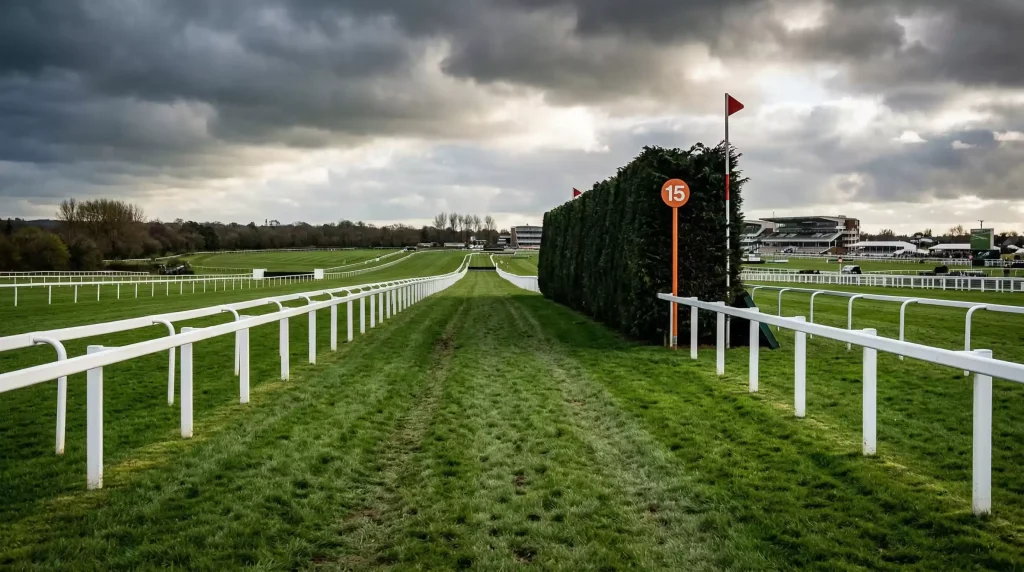
Every horse race has a course. The Grand National has a battlefield. Four miles and two and a half furlongs of undulating turf, 30 fences — 16 unique obstacles jumped twice on a figure-of-eight circuit — and a finishing straight that has produced some of the most dramatic moments in the history of sport. The Aintree National course is not like any other track in British racing. It is longer, more demanding and more unforgiving, and it rewards a very specific combination of stamina, jumping ability and sheer nerve. Understanding the course is not just interesting for its own sake — it is the foundation of any serious Grand National bet.
This guide breaks down the layout, highlights the fences that define the race, and explains how distance and ground conditions feed into the betting market. The toughest test in racing starts here.
The Grand National Course: 4 Miles, 30 Fences, Two Circuits
The Grand National course at Aintree is distinct from the Mildmay course used for other races during the festival. It is a roughly triangular circuit, with the start and finish near the main grandstand and two long sides stretching out into the Aintree countryside. Runners complete nearly two full circuits, taking on 30 fences in total — the first 14 on the opening circuit, then 16 more on the second (the same fences, with two additional obstacles near the finish).
The total distance of approximately four miles and two and a half furlongs makes it the longest race in the British calendar. For context, a typical flat race covers one to one and a half miles; the Cheltenham Gold Cup, the other marquee jumps race, is three miles and two furlongs. The Grand National demands a horse that can sustain its effort over roughly nine minutes of racing — roughly double the duration of most competitive steeplechases. That endurance requirement is what makes the race so unpredictable: even the most talented horse can tire, make an error and lose everything in the final half-mile.
Recent years have brought significant changes to the course. Since 2026, the maximum field has been reduced from 40 to 34, and several fences have been modified or relocated to improve safety. Becher’s Brook, the most notorious obstacle on the course, was moved 60 yards closer to the start to reduce the speed at which horses approach it. These changes, driven by the Jockey Club and the BHA, have altered the character of the race without diminishing its challenge. The Grand National is still the toughest test in racing — it is just a fairer one.
As Greg Ferris of Entain has described it, the Grand National is among those “cultural phenomena that transcend sports.” The course is a central part of that identity. It is not just a track — it is a landscape that has shaped the mythology of British horse racing for nearly two centuries.
Iconic Fences: Becher’s Brook, The Chair and Canal Turn
Of the 16 unique fences on the Grand National course, three stand out as defining obstacles — landmarks that even casual viewers recognise by name.
Becher’s Brook is the sixth fence on the first circuit (and the 22nd on the second). It is named after Captain Martin Becher, who fell into the brook on the landing side during the inaugural race in 1839 and reportedly hid in the water while the rest of the field thundered past. The brook runs along the far side of the fence, creating a drop on landing that is steeper than any other obstacle on the course. Horses that jump it cleanly gain ground; those that get too close to the top of the fence can pitch forward on landing. The 2026 relocation moved the fence slightly, but the brook remains a genuine test of jumping technique and jockey bravery.
The Chair is the largest fence on the course — four feet ten inches high with a six-foot-wide ditch on the take-off side. It is the 15th fence, jumped only once (on the first circuit), and it sits directly in front of the grandstand. The Chair demands respect: its height and the ditch on the approach force horses to take off early and jump with genuine athleticism. Falls here happen in full view of the crowd, which adds to the fence’s fearsome reputation. Despite its size, The Chair’s injury record is better than several less dramatic fences — partly because horses tend to give it the attention it demands.
Canal Turn is the eighth fence on the first circuit (and the 24th on the second). The fence itself is not the main challenge — it is the ninety-degree left-hand turn immediately after landing that makes the Canal Turn unique. Horses jumping on the inside of the field have a shorter route around the turn, which can create bunching and jostling. Horses on the outside must take a wider line and lose ground. The Canal Turn is where race position and tactical awareness become critical, and jockeys who know the course well gain a significant advantage.
Beyond these three, every fence on the National course has its own characteristics. Valentine’s Brook (the ninth and 25th) has a brook on the landing side, similar to Becher’s but less severe. The Water Jump (the 16th) is a low, wide obstacle that requires a different technique from the upright fences. The final two fences — the 29th and 30th — are smaller than those on the rest of the course, but tired horses and tired jockeys still make errors there, and many a Grand National has been lost at the last.
Distance, Going and How Course Conditions Affect Betting
The extreme distance of the Grand National means that ground conditions have an outsized impact on the race outcome. On soft or heavy ground, the stamina demands increase dramatically — horses that have the pace to win over three miles may simply not stay the trip over four. On good ground, speed horses have a better chance, and the completion rate tends to be higher because horses are not slogging through energy-sapping mud.
The going at Aintree in April is typically described as Good to Soft or Soft, though it varies with the weather. The course’s drainage has improved over the years, and Aintree’s groundstaff actively manage the surface, but the classic National ground remains on the softer side — rewarding stamina over speed and favouring horses that handle cut in the ground.
For bettors, the going is a critical variable. A horse’s past performance on different ground types — its “going preference” — is one of the most reliable indicators of whether it will handle the conditions on the day. Horses that have won on soft ground at long distances are better equipped for the Grand National than those whose best form is on firmer surfaces over shorter trips. Checking the going report on the morning of the race and cross-referencing it with each runner’s ground preference is one of the simplest and most effective forms of Grand National analysis.
British racing as a whole attracted 5.031 million racecourse visitors in 2026 — a post-pandemic record. Aintree accounts for a significant share of that total, and the course conditions on Grand National day are scrutinised more closely than at any other fixture in the calendar. When 150,000 people pass through the gates and millions more watch on television, the state of the ground beneath the horses’ hooves becomes front-page news. The toughest test in racing starts not with the first fence, but with the earth beneath it.