
Betting at Aintree: Your On-Course Guide to Grand National Day
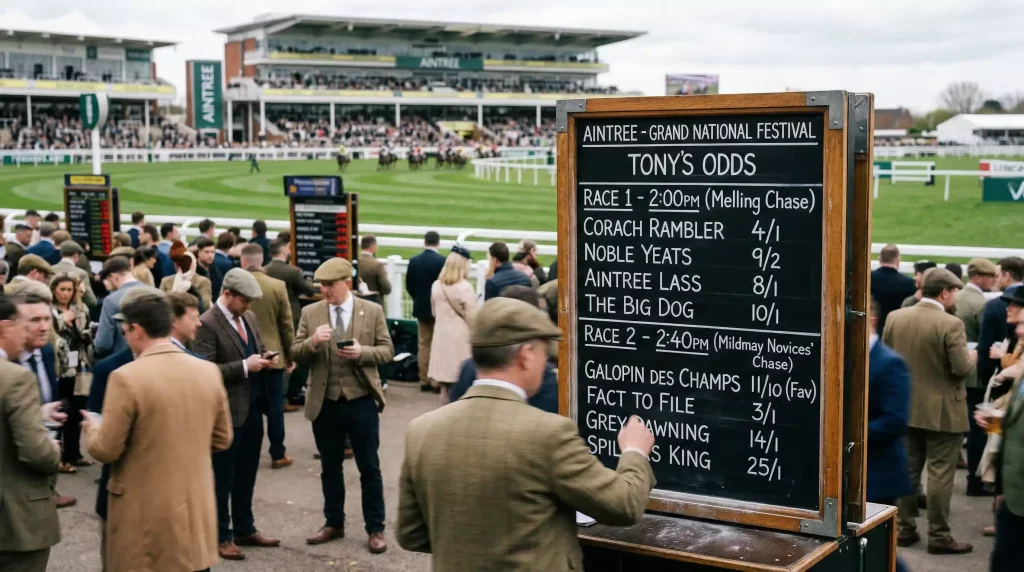
There is nothing in British sport quite like the Aintree betting ring on Grand National afternoon. The noise, the colour, the sheer press of people — around 150,000 racegoers pass through the festival gates over three days — create an atmosphere that no screen can replicate. Placing a bet at the course is a different experience from tapping a phone screen. The prices are shouted, the transactions are face-to-face, and the buzz of the betting ring is part of the fabric of the day.
If you are attending the Grand National in person for the first time — or the first time in years — this guide covers what to expect in the betting ring, how to place a bet at the track, and how the Tote pool system works as an alternative to backing with the bookmakers.
What to Expect in the Aintree Betting Ring
The betting ring is the designated area of the racecourse where on-course bookmakers set up their pitches. At Aintree, it sits in the heart of the course between the stands and the parade ring, and on Grand National day it is one of the most vibrant, chaotic and entertaining spaces in all of British sport.
On-course bookmakers are independent operators — they are not branches of Bet365 or William Hill. Each one sets their own prices, displayed on boards behind their pitch, and those prices can differ from one bookie to the next. Part of the art of betting at the track is walking the ring and comparing prices before committing your cash. A horse might be 14/1 with one bookmaker and 16/1 with the one three pitches down. That difference adds up, and seasoned racegoers will tell you that the best value on course is found by the punter who takes the time to shop around.
The ring is divided into tiers. The most prominent bookmakers — the ones with the biggest pitches and the most staff — occupy the front row, closest to the stands. Their prices tend to be tighter (less generous to the punter) because they attract the highest volume of bets. Behind them, the smaller operators often offer slightly longer odds to pull in business. If you are not in a rush, the back rows can be where the value hides.
The atmosphere intensifies as race time approaches. Prices change rapidly in the final ten minutes before the off — a horse that has been drifting in the market all afternoon might suddenly shorten as money arrives, or an unexpected drifter might lengthen as the ring collectively loses confidence. On-course bookmakers react to the money in front of them, and the last few minutes of trading are when the most dramatic price swings happen. For anyone who enjoys the human drama of a betting market, the ring is the place to be.
One practical note for newcomers: the betting ring can feel overwhelming if you have never experienced it before. The noise, the crowds and the rapidly changing boards can make it hard to think clearly. Give yourself time. Walk the ring once without betting to get a feel for the layout and the prices, then go back to the pitch where you saw the best value. And keep your betting slip safe — without it, collecting your winnings becomes a headache.
Placing a Bet at the Track: Cash, Cards and the Betting Slip
The process of placing a bet at Aintree is refreshingly simple. You walk to a bookmaker, state your selection and your stake, and hand over your money. The bookmaker gives you a printed slip — your receipt — which you present to collect your winnings after the race. That is it. No account registration, no identity verification, no password reset at the worst possible moment.
Cash has traditionally been the primary currency of on-course betting, and it still works everywhere. However, most on-course bookmakers now accept card payments through portable terminals, and some offer contactless for smaller stakes. The shift has been gradual, but practical: carrying large amounts of cash on a busy race day is not everyone’s idea of fun, and card payments make it easier to control your spending (no more trips to the cash machine when the wallet runs dry).
To place your bet, you need to know a few things: the name or number of the horse, the type of bet (win, each-way, forecast, etc.), and your stake. The bookmaker will confirm the odds at the point of transaction — whatever price they are showing on their board when you hand over the money is the price you get. This is subtly different from online betting, where the price can change between adding a selection to your bet slip and confirming the bet. At the track, the transaction is immediate and face-to-face.
The scale of betting activity on Grand National day is extraordinary. Entain alone processes upwards of 15,000 bets per minute at peak moments — and that is just one operator’s retail and digital operation. At the course, the betting ring absorbs thousands of transactions in the final minutes before the off. If you have a specific price in mind, do not leave it too late. The best on-course prices often disappear in the last five minutes as the ring adjusts to late money.
Tote Pool Betting at Aintree: Placepot, Jackpot and More
If the bookmaker ring is not your style, the Tote offers an entirely different way to bet at Aintree. The Tote operates a pool betting system — instead of betting against the bookmaker, you are betting into a shared pool with other punters. The final dividend (payout) is determined by the total pool size and the number of winning tickets. There are no fixed odds: you do not know what you will win until after the race.
The simplest Tote bet is the Win pool — you pick the winner, and your share of the pool depends on how many others also backed that horse. The Place pool works the same way for placed finishers. These are straightforward alternatives to backing with the ring bookmakers, and the Tote dividend can sometimes exceed the starting price offered by bookmakers, particularly when a popular horse in the ring is underrepresented in the Tote pool.
More popular at the Grand National are the multi-race pools. The Placepot requires you to pick a horse to finish in the places in each of the first six races on the card — including the Grand National itself. Getting all six right can produce substantial dividends from a small unit stake, and the Placepot has become a Grand National day tradition in its own right. The Jackpot and the Scoop6 work on similar principles but require you to pick the winner rather than a placed horse, making them harder to land but offering even bigger payouts.
The Tote has physical kiosks at Aintree as well as self-service terminals and a mobile app. You can also place Tote bets through some bookmaker platforms. For those who find the betting ring intimidating or who prefer the communal aspect of pool betting, the Tote is a relaxed and accessible way to get involved. There is something satisfying about checking the pool totals, realising that your obscure Placepot pick has attracted very little money, and knowing that if it lands, the dividend will be something special. The buzz of the betting ring takes many forms — and the Tote queue has its own quiet excitement.