
Fractional and Decimal Odds Explained: A Horse Racing Conversion Guide
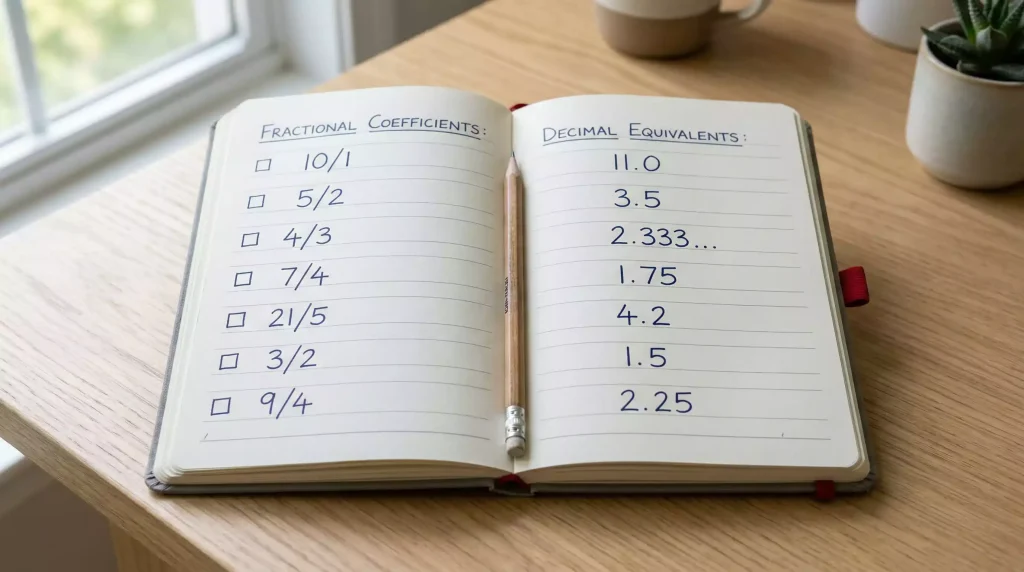
If you have ever looked at a Grand National market and been confused by the numbers, you are not alone. British horse racing traditionally uses fractional odds — 10/1, 5/2, 11/4 — while betting exchanges, European bookmakers and many online platforms display decimal odds — 11.0, 3.50, 3.75. Both formats express exactly the same thing: the potential return on your bet relative to your stake. The difference is purely presentational, but if you are not comfortable reading both, it can feel like trying to follow a recipe in a foreign language.
This guide takes the mystery out of odds formats. By the end of it, you will be able to read any price in either format, convert between them without a calculator, and understand what the numbers really tell you about a horse’s chances. Numbers made simple — that is the goal.
Fractional Odds: How to Read 10/1, 5/2 and Odds-On Prices
Fractional odds are the traditional format used in British and Irish horse racing. They are expressed as two numbers separated by a slash: 10/1, 5/2, 7/4, 1/3, and so on. The first number represents the profit you stand to make; the second represents the stake required to make that profit.
At 10/1 (said as “ten to one”), you win £10 for every £1 you stake. A £5 bet at 10/1 returns £50 in profit plus your £5 stake — £55 in total. This is the simplest form of fractional odds and the easiest to calculate: just multiply your stake by the first number.
At 5/2 (said as “five to two”), you win £5 for every £2 you stake. A £10 bet at 5/2 returns £25 in profit plus your £10 stake — £35 total. To calculate the return for any stake, divide your stake by the second number and multiply by the first. So £10 divided by 2 equals 5, multiplied by 5 equals £25 profit.
At 7/4 (“seven to four”), you win £7 for every £4 staked. A £4 bet returns £7 profit plus £4 stake — £11 total. The pattern holds: divide the stake by the denominator, multiply by the numerator.
Odds-on prices are where the second number is larger than the first: 1/2, 4/5, 1/3. These indicate a horse that is considered more likely to win than to lose. At 1/2 (“one to two” or “two to one on”), you win £1 for every £2 staked. Your return is smaller than your outlay, reflecting the horse’s short price. Odds-on runners are rare in the Grand National — the race is too unpredictable for any horse to start at cramped odds — but they are common in shorter, smaller-field races.
The Grand National’s prize fund reached £1 million in 2026, with the winner taking £500,000. The fact that even the most fancied horse in the race rarely starts shorter than 5/1 or 6/1 gives some sense of how open the betting market is — and why understanding longer fractional prices like 25/1 or 33/1 matters for anyone betting on the race.
There is one more concept worth understanding alongside fractional odds: implied probability. A horse priced at 10/1 has an implied probability of roughly 9.1% — meaning the market thinks it has about a one-in-eleven chance of winning. At 4/1, the implied probability is 20%. At evens (1/1), it is 50%. The formula is simple: divide the second number by the sum of both numbers, then multiply by 100. For 10/1: 1 ÷ (10+1) × 100 = 9.1%. This helps you judge whether a price represents value — if you believe a horse has a 15% chance of winning but the market prices it at 10/1 (9.1%), the odds are in your favour.
Decimal Odds: The European Format Made Simple
Decimal odds express the total return on a £1 stake, including the stake itself. They are the standard format on betting exchanges, across continental Europe, and increasingly on UK bookmaker websites and apps (where you can usually toggle between formats).
At 11.0 decimal odds, a £1 bet returns £11 — which is £10 profit plus the £1 stake. This is exactly the same as 10/1 in fractional format. The decimal number always includes your stake, which is the key difference: fractional odds show profit only; decimal odds show total return.
At 3.50, a £1 bet returns £3.50 — which is £2.50 profit plus the £1 stake. This is the same as 5/2 fractional. At 2.75, a £1 bet returns £2.75 (£1.75 profit) — the same as 7/4.
The beauty of decimal odds is that the calculation is always a single multiplication. Whatever the decimal price, multiply it by your stake to get the total return. A £10 bet at 6.0 returns £60. A £5 bet at 21.0 returns £105. There is no need to work with two numbers and a slash — just one number and a multiply.
Decimal odds also make it easier to compare prices at a glance. Is 11/4 better or worse than 3.80? In fractional format, you need to do a mental conversion. In decimal, 11/4 is 3.75 — so 3.80 is the better price. For quick market scanning, decimal wins on clarity every time.
Odds-on prices in decimal format are any number less than 2.0. At 1.50 decimal (equivalent to 1/2 fractional), a £10 bet returns £15 — £5 profit and the £10 stake. At 1.33 (equivalent to 1/3), a £10 bet returns £13.33. Decimal makes it immediately clear how small the profit margin is on odds-on bets.
Converting Between Formats: Quick Reference and Formula
The conversion between fractional and decimal odds is straightforward once you know the formula.
Fractional to decimal: divide the first number by the second, then add 1. So 10/1 becomes (10 ÷ 1) + 1 = 11.0. And 5/2 becomes (5 ÷ 2) + 1 = 3.50. And 7/4 becomes (7 ÷ 4) + 1 = 2.75. The “+1” accounts for the stake being included in the decimal format.
Decimal to fractional: subtract 1 from the decimal number, then express the result as a fraction. So 11.0 becomes 11.0 − 1 = 10, which is 10/1. And 3.50 becomes 3.50 − 1 = 2.50, which is 5/2 (multiply both sides by 2). And 2.75 becomes 2.75 − 1 = 1.75, which is 7/4 (multiply both sides by 4).
For a real Grand National example: Nick Rockett won the 2026 Grand National at 33/1. In decimal, that is (33 ÷ 1) + 1 = 34.0. A £5 each-way bet on Nick Rockett at 33/1 would have returned £165 on the win part (£5 × 33) plus the place payout at 1/4 odds (33/4 = 8.25/1, so £5 × 8.25 = £41.25) — a total of £216.25 from a £10 total stake. In decimal terms, the same calculation: £5 × 34.0 = £170 total return on the win, £5 × 9.25 = £46.25 total return on the place. Same money, different notation.
Most bookmaker websites and apps allow you to switch between fractional and decimal at the click of a button. If you are more comfortable with one format, there is no obligation to use the other. But understanding both gives you the flexibility to use whichever platform offers the best price — and on Grand National day, when every fraction of a point matters, that flexibility is worth having. Numbers made simple, and numbers that make you money.