
Grand National Going and Ground Conditions: What They Mean for Your Bet
 Available in US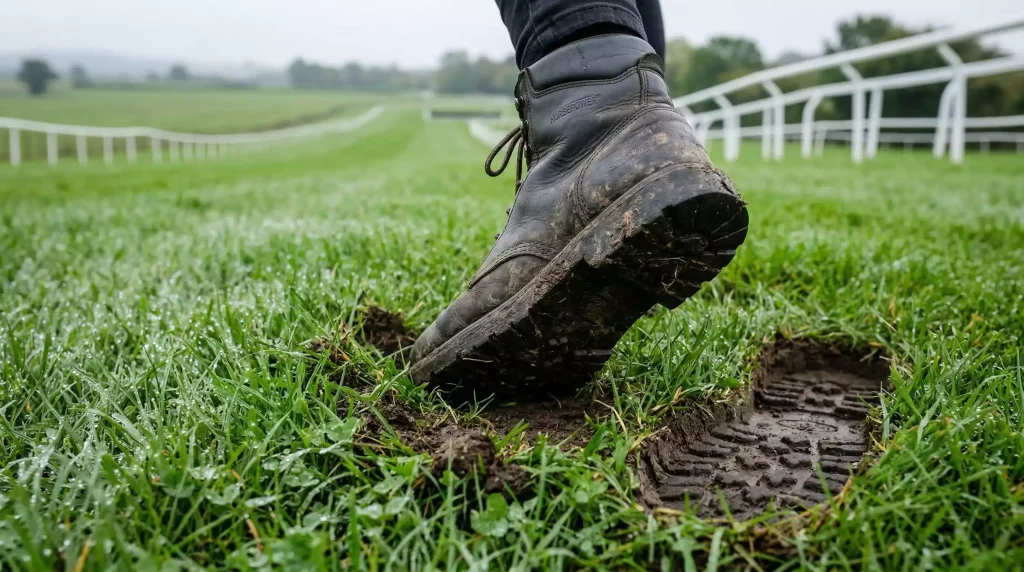
Ask any seasoned punter what the single most important variable in a Grand National bet is, and the answer is rarely the horse, the jockey or the trainer. It is the ground. The going — the official description of the state of the racing surface — shapes everything: which horses are suited, how fast the race is run, how many runners complete the course and, ultimately, who wins. A horse that floats over soft ground like it is dancing can become a labouring wreck on firm. A quick, nimble jumper that excels on a fast surface can be swallowed up by energy-sapping heavy ground at Aintree.
The ground tells a story, and learning to read it is one of the most practical skills a Grand National bettor can develop. This guide explains what the going actually is, how it is measured, what each description means, and how to factor it into your betting.
Ground feeds straight into the betting tips.
What Is the Going? How Ground Conditions Are Measured
The going is the official assessment of the racing surface’s firmness on the day of racing. It is determined by the clerk of the course — the person responsible for managing the track at each racecourse — using a combination of physical measurement and professional judgement.
The primary measuring tool is the GoingStick, a device developed by Cranfield University and TurfTrax that is pushed into the turf at multiple points around the course. It measures both vertical penetration and shear resistance on a numerical scale from 0 (softest) to 15 (hardest), with typical published readings falling between roughly 4.5 and 12.0. The readings are taken at regular intervals — usually daily in the days before a major meeting, and again on race morning — and the clerk uses them alongside a visual inspection of the surface and the weather forecast to declare the official going.
At Aintree, the going is typically declared on the morning of each day of the festival, with updates issued if conditions change significantly during the day (heavy rain, for example, or a drying wind). For the Grand National itself, the going is usually confirmed by mid-morning on race day, giving punters several hours to assess the conditions and adjust their selections accordingly.
The going description is not a single fixed point — it reflects the average condition across the course, and different parts of the track can ride differently. The inside rail may be more worn and softer than the outside; the area around the take-off and landing of fences may be chewed up after two days of earlier racing. The clerk’s description is a summary, not a precision measurement, and experienced racegoers know to factor in how the ground might vary across the four-mile circuit.
Weather is the wild card. April in the north-west of England is unpredictable — sunshine one hour, rain the next. A course that is declared Good to Soft on Friday morning can be Soft or even Heavy by Saturday afternoon if a weather front moves through. Punters who check the forecast obsessively in the 48 hours before the Grand National are not paranoid — they are doing essential homework.
From Firm to Heavy: Every Going Description Explained
The official going descriptions used in British racing run on a scale from the driest to the wettest conditions. Here is what each one means in practice.
Hard — extremely dry, baked ground. Very rare in the UK, almost never seen at Aintree in April. Dangerous for jump racing because the impact on landing is severe, and meetings are sometimes abandoned if the ground is too hard.
Firm — dry, fast ground. Also uncommon at Aintree in spring. Suits speed horses and those with a low, efficient jumping style. The race tends to be run faster on firm ground, which can expose stamina limitations in the later stages.
Good to Firm — on the drier side of ideal. Quick ground that still has some give in it. Favours horses with pace and those that prefer to skip across the surface. Uncommon at Aintree for the Grand National but not unheard of in dry springs.
Good — the benchmark. The surface has a good balance of firmness and cushion. Most horses handle Good ground, and the going does not confer a significant advantage or disadvantage to any particular type. Race times on Good ground at Aintree are generally faster than on softer surfaces.
Good to Soft — the most common going at Aintree in April. There is more moisture in the ground, which provides additional cushion but also demands more energy from the horses. Favours stamina over speed and suits horses that handle cut in the ground.
Soft — wet, testing ground that significantly increases the stamina demands. The race is run slower, the fences become more challenging because the take-off ground is slippery, and the completion rate tends to drop. Horses need to be genuine stayers with proven form on soft ground.
Heavy — waterlogged, energy-sapping conditions. The most extreme going description, and one that transforms the Grand National into a war of attrition. Only horses with exceptional stamina and the ability to plough through deep ground have any chance. Meetings are occasionally abandoned if the ground is dangerously heavy.
Since 2026, changes to the Grand National course — including the relocation of the first fence 60 yards closer to the start and the reduction of the field to 34 runners — have been designed in part to reduce the impact of challenging ground conditions on horse safety. The modifications mean that even on softer ground, the risks at the early fences are somewhat mitigated.
The BHA’s Director of Racing, Richard Wayman, has acknowledged the broader impact of racing conditions on the industry, noting that the decline in betting turnover is primarily driven by affordability checks, with factors including ground conditions playing into the overall patterns. When courses are waterlogged and meetings are abandoned or rescheduled, the knock-on effects are felt across the entire betting ecosystem.
The wider context is set out in our Grand National betting guide.
How Going Conditions Affect Grand National Betting
The practical impact of the going on your Grand National bet is significant, and it works through several channels.
First, the going directly affects which horses are suited. Every horse has a ground preference — some are described as “ground-dependent” because their performance drops markedly on the wrong surface. Checking a horse’s form on the prevailing going is one of the simplest and most effective filters you can apply to the 34-runner field. If the going is Soft and your horse has never won on anything worse than Good, that is a red flag.
Second, the going affects the pace of the race and the completion rate. On soft or heavy ground, the field tends to stretch out, with tired horses falling away in the final mile. This increases the value of each-way bets, because horses that might not have the class to win can still stay the trip well enough to fill a place position. On faster ground, the field is more tightly bunched, and the finish tends to be more competitive.
Third, the going influences late market movements. When the official going is declared on race morning, it can trigger a rush of betting activity as punters back horses suited to the conditions and oppose those that are not. If the going changes from the expected Good to Soft to a surprise Soft or Heavy, the market can move sharply — and the best value often lies in reacting quickly to a going change that the wider public is slow to price in.
British racecourse attendance reached 5.031 million in 2026, with Aintree among the most popular courses in the calendar. For the tens of thousands who attend the Grand National in person and the millions who watch on television, the going is the first piece of information that sets the tone for race day. Check it, respect it, and let it guide your selection. The ground tells a story — and the punters who listen to it tend to be the ones collecting at the end of the afternoon.
