
Grand National Payout Guide: How Returns Are Calculated, with Examples
 Available in US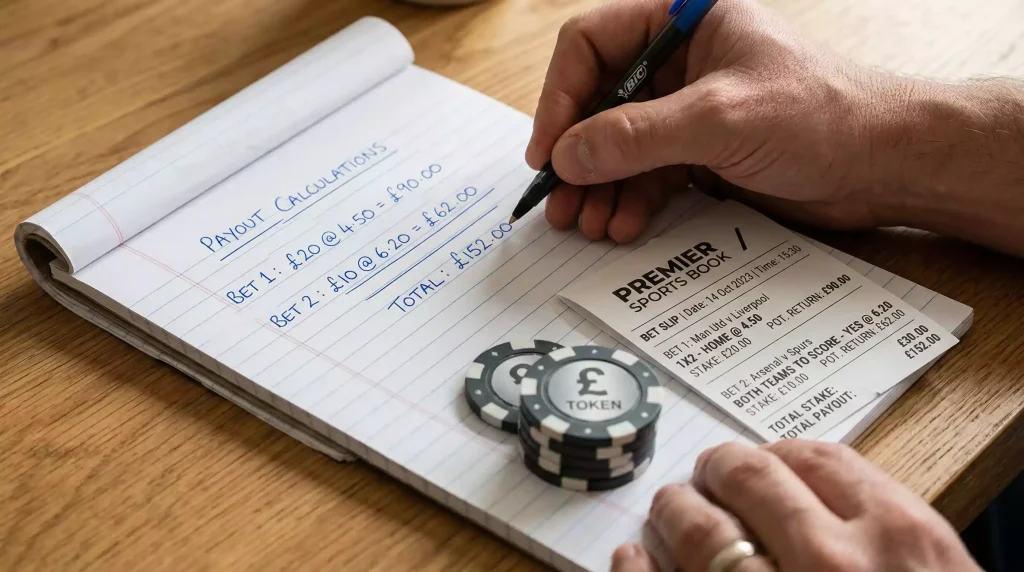
You have picked your horse, placed your bet and watched it cross the line. Now comes the question every punter asks: how much did I actually win? The answer depends on the type of bet, the odds, the place terms and — in some situations — whether a deduction has been applied. Grand National payouts are not always as straightforward as multiplying the odds by the stake, and the difference between knowing what you will win and guessing at it can be the difference between satisfaction and confusion at the payout counter.
This guide walks through the core payout formula for each major bet type, provides worked examples using realistic Grand National odds, and explains the two situations — dead heats and Rule 4 deductions — that can reduce your return. Know what you’ll win before the race, not after.
The place part is explained in each-way betting.
How Grand National Payouts Work: The Core Formula
The basic payout calculation is the same for every fixed-odds bet: multiply your stake by the odds, and that gives you your profit. Add the stake back, and you have the total return. The complication comes from the different bet types and their specific rules.
Win bet. The simplest calculation. If you back a horse at 20/1 for £5, your profit is £5 × 20 = £100. Add the £5 stake and your total return is £105. In decimal odds, the same bet at 21.0 returns £5 × 21.0 = £105 total (stake included). If the horse does not win, you lose the £5 stake.
Each-way bet. An each-way bet is two bets: one on the win and one on the place. If you bet £5 each way at 20/1 with 1/4 odds and four places, your total outlay is £10. If the horse wins, the win part pays £100 profit and the place part pays at 20/4 = 5/1, which is £25 profit — total profit £125, total return £135 (including both stakes). If the horse places but does not win, you lose the £5 win stake but collect £25 profit on the place part plus the £5 place stake — total return £30 from a £10 outlay, netting you £20 profit.
The majority of Grand National punters bet at these levels. Entain’s data from the 2026 Grand National showed that 82% of in-shop bets were for £5 or less. A £2 each-way bet — £4 total — on a 25/1 winner returns £54 on the win part and £14.50 on the place part, a total of £72.50 from a £4 outlay. These are the kinds of payouts that make the Grand National so appealing to casual bettors: small stakes, big multiples.
Forecast and tricast. Payout on forecasts and tricasts is calculated differently. Rather than fixed odds, these bets pay a dividend based on the Computer Straight Forecast (CSF) formula, which takes the starting prices of the relevant horses and calculates a return. The dividend is not known until after the race, which means you cannot calculate your exact payout in advance. What you can know is that forecast and tricast dividends on the Grand National — with its large field and frequent long-priced finishers — tend to be very large indeed.
Worked Examples: Win, Each-Way and Forecast Returns
Let us work through three realistic scenarios using the 2026 Grand National result as a reference. Nick Rockett won at 33/1.
Example one: £5 win bet on Nick Rockett at 33/1. Profit = £5 × 33 = £165. Total return = £170 (profit plus stake). In decimal: £5 × 34.0 = £170.
Example two: £5 each-way bet on Nick Rockett at 33/1, four places at 1/4 odds. Win part: £5 × 33 = £165 profit. Place part: 33/4 = 8.25/1, so £5 × 8.25 = £41.25 profit. Total profit = £206.25. Total return = £216.25 (including both £5 stakes). If Nick Rockett had placed but not won, the place return alone would have been £41.25 profit plus the £5 place stake = £46.25 — comfortably covering the £10 total outlay.
Example three: £1 straight forecast — Nick Rockett first, second-placed horse second. The CSF dividend depends on the starting prices of both horses. With a 33/1 winner and a second horse at, say, 12/1, a typical CSF return might be in the region of £400 to £600 from a £1 unit stake. The exact figure varies based on the formula, but the principle is clear: correctly predicting the first two in a 34-runner race produces a dividend that dwarfs a simple win bet.
Example four: £2 Tote Placepot. The Placepot dividend depends on the pool. If the Placepot pool is £2 million and only 500 winning tickets exist, the dividend per £1 unit is £4,000 — so a £2 stake returns £8,000. In practice, Grand National Placepot dividends range from modest (under £100) to spectacular (several thousand), depending on how many legs produce popular results versus surprises.
The wider context is set out in our Grand National betting guide.
Dead Heats and Rule 4 Deductions: What Reduces Your Payout
Two situations can reduce your Grand National payout below what the raw odds suggest: dead heats and Rule 4 deductions.
Dead heats occur when two or more horses cannot be separated at the finishing line. In a dead heat for first place, the payout on win bets is halved: you are paid at full odds to half your stake, and the other half of your stake is lost. For each-way bets, a dead heat for a place position works the same way — the place payout is calculated to half the stake. Dead heats are rare in the Grand National, but they do happen, and the payout reduction catches punters off guard if they are not expecting it.
For example, if you have a £10 win bet at 20/1 and your horse dead-heats for first, your payout is calculated as £5 (half the stake) × 20 = £100 profit, plus the £5 half-stake returned = £105. You lose the other £5. Compare that to the full-win payout of £210 and the sting is obvious.
Rule 4 deductions apply when a horse is withdrawn from a race after the final declaration stage but before the off. The withdrawal changes the market, because the remaining horses all become slightly more likely to win (or place). To compensate for this, bookmakers apply a deduction to winning bets based on the starting price of the withdrawn horse. The deduction is expressed in pence per pound: a 10p deduction means your payout is reduced by 10%. A 25p deduction means a 25% reduction.
The scale of the deduction depends on the price of the withdrawn horse. If a 100/1 outsider is withdrawn, the deduction is minimal — perhaps 5p in the pound. If a 3/1 favourite is withdrawn, the deduction can be as much as 45p in the pound, which takes a serious chunk out of your return. Rule 4 deductions are automatically applied by the bookmaker — you do not need to calculate them yourself — but knowing that they exist and how they work prevents the unpleasant surprise of a payout that is lower than expected.
On Grand National day, late withdrawals are not uncommon. A horse might fail a veterinary inspection on the morning of the race, or the trainer might decide the ground is unsuitable. If a Rule 4 deduction is applied, it affects every bet on the race — not just bets on the withdrawn horse. Checking whether any deductions are in force before collecting your winnings is a sensible habit. Know what you’ll win — and know what might reduce it.
