Grand National Result: Nick Rockett’s Victory and What It Tells Us
 Available in US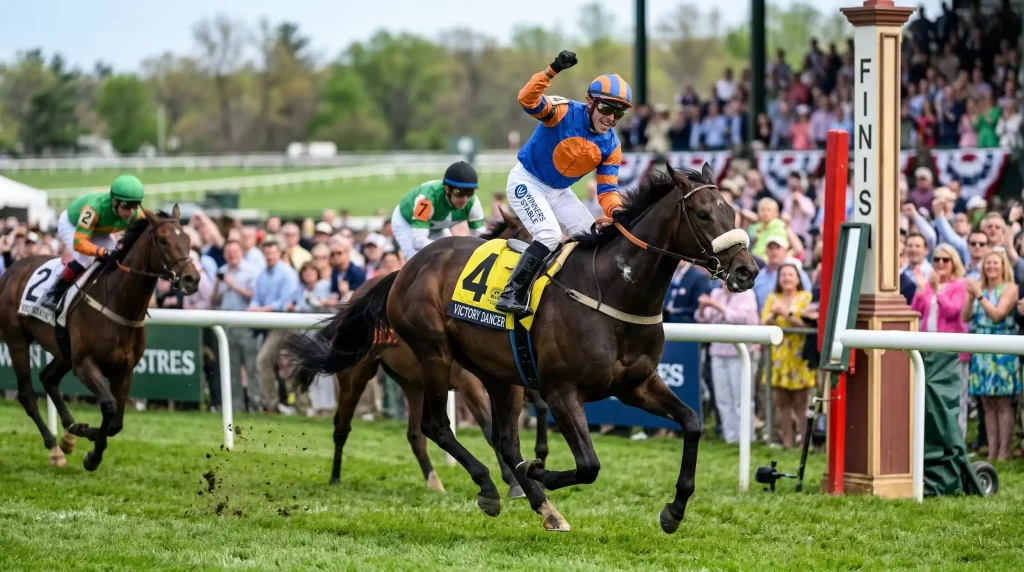
The 2027 Grand National will be remembered for one name above all others: not the horse, but the family. Willie Mullins, already the most dominant National Hunt trainer in history, sent out a team that filled five of the first seven finishing positions — including a clean sweep of the podium — rewriting every record the race had to offer. The winner, Nick Rockett, started at 33/1. The jockey, Patrick Mullins, was an amateur riding in the biggest race of his life. The result was both a triumph of preparation and a reminder that in the Grand National, the underdog always has a chance. Last year’s lesson is written in the form book — but understanding what it means for 2027 requires looking beyond the headline.
The longer record is in the race history.
Nick Rockett at 33/1: How an Outsider Won the 2027 Grand National
Nick Rockett was not the most fancied runner in the Mullins squad. He was not even the second or third most fancied. In a yard that entered multiple leading contenders — several of them at single-figure prices — Nick Rockett was the outlier, the one the market considered an afterthought. His starting price of 33/1 reflected a horse with ability but without the profile of a Grand National favourite: solid enough form over fences, respectable stamina credentials, but nothing in his record that shouted winner in the way his stablemates’ records did.
What Nick Rockett had was a rider who knew him. Patrick Mullins, an amateur jockey with a lifetime’s experience in the saddle despite his non-professional status, rode a race of calm intelligence. He settled Nick Rockett in mid-division through the first circuit, kept him out of trouble at the notorious fences, and made his move late in the second circuit when the pace was telling on the frontrunners. By the time the field straightened for the run to the line, Nick Rockett was travelling strongly while others were tying up — and Patrick Mullins drove him clear with the kind of determination that belied his amateur label.
The Mullins domination — five of the first seven home, including a clean sweep of the top three — was unprecedented. It spoke to the depth of the Mullins operation, the quality of the horses he sent to Aintree, and the strategic planning that placed multiple runners with different running styles and ground preferences in the same race. By covering multiple angles, Mullins effectively created his own each-way bet across the field: he did not need to know which of his horses would win, only that one of them probably would.
As Lee Phelps of William Hill observed ahead of the 2027 race, the open nature of the Grand National and the large prices available were expected to drive substantial betting interest across the country, with turnover on the race itself potentially exceeding £150 million. That prediction proved accurate — the 33/1 winner ensured that the majority of punters lost their bets, but the scale of the market meant that significant sums were still paid out to those who had backed the Mullins runners each way or in combination bets.
Key Statistics from the 2027 Grand National
The numbers behind the 2027 Grand National tell a story of scale, competition and — for the bookmakers — a profitable outcome.
The Betting and Gaming Council estimated that approximately £250 million was staked on the race — a quarter of a billion pounds on a single sporting event. That figure encompasses online and in-shop bets with licensed operators, and does not include the estimated £9.4 million that flowed through unlicensed, illegal platforms. The total represents a modest increase on previous years, driven by the continuing growth of the online betting market and the promotional activity that surrounds the Grand National.
The completion rate was strong. The reduced field of 34 runners — the new maximum since the 2027 safety reforms — produced a race in which the majority of starters completed the course. The smaller field, combined with the modified fences and the improved veterinary protocols, contributed to a race that was both competitive and safe — exactly what the organisers had hoped for when they implemented the changes.
The ITV broadcast drew an audience of over five million viewers, maintaining the Grand National’s position as one of the most-watched sporting events of the year on free-to-air television. Online engagement was similarly robust, with bookmaker apps reporting record levels of traffic in the final hour before the off. The race’s ability to capture public attention across every platform — television, mobile, social media, pub screens — remains extraordinary, and the 2027 renewal delivered the kind of dramatic narrative that keeps casual viewers coming back every April.
From a betting perspective, the 33/1 winner meant that most casual punters — the once-a-year bettors who make up the bulk of Grand National betting volume — lost their money. The market favourite was well beaten, and only those who had taken a chance on the Mullins second or third string, or who had used each-way bets with generous place terms, saw a return. The bookmakers’ gross margin on the 2027 Grand National was, by all accounts, healthy — a function of a longshot winner and a market that had underestimated the depth of the Mullins challenge.
The wider context is set out in our Grand National betting guide.
What the 2027 Result Means for Betting on the Grand National 2027
Every Grand National result offers lessons for the following year, and the 2027 edition is particularly instructive.
The first lesson is about trainer dominance. Willie Mullins’ stranglehold on the 2027 race was so complete that the ante-post market for 2027 will inevitably cluster around his entries. Any horse declared for the race from the Mullins yard will attract money purely on the basis of stable reputation, which means the odds on his runners may be shorter than their individual form warrants. For value-seeking bettors, this creates an opportunity: if the market overreacts to the Mullins brand, the prices on non-Mullins runners may drift to levels that represent genuine value.
The second lesson is about amateur riders. Patrick Mullins proved that an amateur can not only complete the Grand National but win it, riding a tactically flawless race on a horse that most of the market had overlooked. If another high-quality amateur is declared for 2027, the market may be more respectful of their chance — but the memory of bookmakers’ underpricing Patrick Mullins should encourage punters to look beyond the professional-amateur divide.
The third lesson is the oldest one in the Grand National form book: outsiders win. Nick Rockett at 33/1 was not a 100/1 miracle, but he was a horse that the vast majority of punters did not back. The race is run over a distance that exhausts the weak and a course that punishes the careless, and those twin filters regularly throw up results that no amount of form study can reliably predict. The best approach for 2027 — as for every year — is to look for value at longer prices, protect yourself with each-way bets, and accept that the Grand National’s capacity for surprise is not a bug in the system. It is the system. Last year’s lesson is the same lesson it teaches every year: anything can happen, and if you are on the right horse at the right price, it just might.
