
UK Horse Racing Industry: Economic Impact, Jobs and the Betting Ecosystem
 Available in US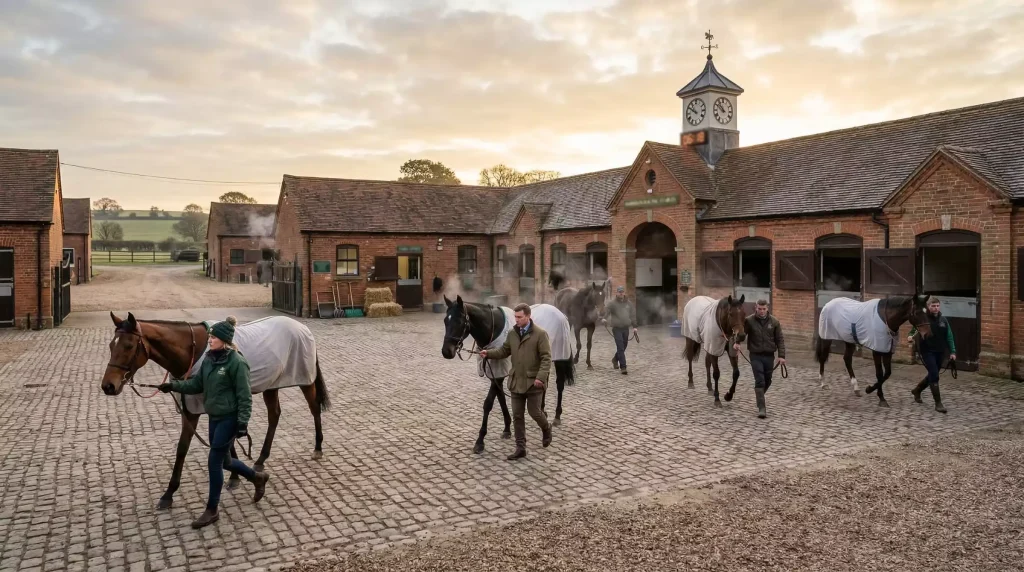
When you place a bet on the Grand National, the transaction feels simple: you hand over a few pounds, pick a horse, and hope for the best. What is easy to forget is the vast economic machinery that sits behind that moment. British horse racing is not just a sport — it is an industry that stretches from breeding farms in the Cotswolds to stable yards in Lambourn, from the betting shops of every high street to the hospitality suites of 59 racecourses across the country.
The numbers are substantial. According to data presented to Parliament by the British Horseracing Authority, the racing industry contributes approximately £4.1 billion to the UK economy and supports around 85,000 jobs. That makes it one of the largest sporting sectors in the country by economic footprint — and betting is the engine that drives most of it. This article looks beyond the betting slip at the industry that makes the Grand National possible.
The levy that funds it is explained in betting tax.
The Scale of British Horse Racing: More Than Just Betting
Britain has around 59 active racecourses, from the flat expanses of Newmarket to the jumps circuits of Cheltenham, Aintree and Haydock. In 2026, racecourse attendance across the country reached 5.031 million — the first time the figure had crossed the five million mark since before the pandemic. That level of footfall translates directly into spending: tickets, food, drink, hospitality packages, transport and accommodation in the towns that host meetings.
But racecourses are only the visible tip. Behind every race day sits a year-round infrastructure. There are approximately 500 licensed trainers in the UK, operating yards that between them house thousands of horses in training at any given time. Each horse requires daily care — feeding, exercise, veterinary attention, farriery — and each yard employs stable staff, work riders, secretaries and ground staff. Then there are the breeders, the bloodstock agents, the transport operators who move horses between courses, the vets who monitor their welfare, and the jockeys who ride them.
This ecosystem is disproportionately rural. Training centres are concentrated in areas like Newmarket (Suffolk), Lambourn (Berkshire), Middleham (North Yorkshire) and across Ireland’s midlands. In many of these communities, the racing industry is not a supplement to the local economy — it is the local economy. A successful training yard in a small market town can be one of the largest private employers for miles around.
The sport is also deeply intertwined with the leisure and tourism sectors. Major festivals — Cheltenham in March, Aintree in April, Royal Ascot in June, the Ebor Festival at York in August — draw visitors from across the UK and internationally. Hotels, restaurants, taxi firms and retailers all benefit. Aintree’s Grand National Festival alone brings an estimated 150,000 visitors to the Liverpool area over three days, with a measurable impact on the local hospitality trade.
How Horse Racing Contributes £4 Billion to the UK Economy
The £4.1 billion figure cited by the BHA in its submissions to Parliament reflects the full economic contribution of the racing sector, accounting for direct spending, indirect effects through the supply chain, and the induced impact of wages spent by racing employees. The direct revenue generated by the industry — from racecourse admissions, media rights, sponsorship, breeding fees and prize money — is estimated at over £1.47 billion annually. The larger figure captures the multiplier effect: every pound spent within the racing industry circulates through the wider economy, supporting businesses that are not themselves part of racing but depend on its activity.
A critical part of this financial picture is the Horserace Betting Levy. The levy is a statutory charge on bookmakers’ profits from horse racing bets, and it is the primary mechanism through which betting revenues flow back into the sport. In 2026, the Horserace Betting Levy Board allocated £70.5 million to prize money, veterinary science, breed improvement and integrity services — an increase of £3.2 million on the previous year. Without the levy, the economics of British racing would collapse: prize money would drop, fewer owners would invest, fewer horses would be trained, and the sport’s ability to sustain itself would be fundamentally compromised.
The relationship between betting and racing is therefore not incidental — it is structural. Betting funds the sport through the levy. The sport provides the product that betting customers want. When betting turnover falls — as it has in recent years, with the BHA reporting a 6.8% decline in 2026 — the levy receipts fall too, and the sport’s finances come under pressure. This circular dependency is what makes debates about affordability checks, advertising restrictions and black market growth so consequential for the racing industry. Every pound lost to an unlicensed operator or deterred by regulatory friction is a pound that does not flow back into the sport.
The wider context is set out in our Grand National betting guide.
Jobs in Racing: From Stable Yards to Racecourse Hospitality
The 85,000 jobs figure covers a remarkably diverse range of roles. At the sharp end are the jockeys, trainers and stable staff who work directly with the horses. A typical National Hunt training yard might employ 20 to 40 staff, from the head lad who oversees daily operations to the apprentice riders and muckers-out who keep the yard running from before dawn. The work is physical, seasonal and often poorly paid at the entry level — but for those who love horses, there is no substitute.
Beyond the yards, the industry supports a network of specialist professions. Equine vets, farriers, nutritionists, physiotherapists and dentists all serve the horse population. Bloodstock agents and breeders operate at the commercial end, buying and selling horses at auction and managing stud farms. Transport companies move horses between courses, between countries and between sales venues. The British racing calendar runs almost year-round — roughly 1,500 fixtures across the country — so this is not a short-season business.
Racecourses themselves are significant employers, especially on race days. Aintree, Cheltenham, Ascot and their peers employ full-time operational staff, but the bulk of race-day labour is casual and seasonal: caterers, bar staff, security, hospitality hosts, car park attendants and stewards. For many of these workers, the Grand National Festival and similar marquee events represent a major income boost during what might otherwise be a quiet period.
There is also a substantial media and technology layer. Racing broadcasters, form data companies, odds comparison platforms and betting technology providers all employ people whose livelihoods are tied to the health of the racing product. When a horse crosses the line at Aintree on Grand National Saturday, the economic ripple extends far beyond the finishing post — through the bookmakers processing the payouts, the broadcasters replaying the footage, and the data providers updating the form database.
What makes the employment picture particularly notable is its geographic distribution. Unlike many UK industries that concentrate jobs in London and the South East, racing employment is spread across the country — and often anchored in rural and semi-rural communities where alternative employment options are limited. From the training heartlands of the Berkshire Downs to the racecourses of the North West and Scotland, from the breeding operations of East Anglia to the point-to-point circuits of the West Country: these are places where the racing industry does not just provide jobs, it sustains communities. The economic chain that begins with a Grand National bet runs all the way to a stable lad feeding a horse at five in the morning — a small part of a very large machine that keeps a lot of people in work well beyond the betting slip.
