
Grand National Each-Way Betting Explained: Places, Payouts and Strategy
The Grand National is, by some distance, the one horse race that turns the entire country into a nation of punters. Millions of people who wouldn’t dream of walking into a betting shop the other 364 days of the year will happily slap a fiver on something with a funny name and spend four minutes gripping the arm of the sofa. And the single most popular way those millions choose to bet is each-way.
There is a good reason for that. The Grand National is chaotic, unpredictable and contested by a field so large that picking the outright winner feels a bit like guessing which raindrop reaches the bottom of the window first. Each-way betting exists precisely for races like this one — your bet in two parts, one backing the horse to win and one backing it simply to finish in the places. It is, in effect, a safety net stitched into the wager itself, and understanding how it works is probably the single most useful thing you can learn before the first Saturday in April.
This guide breaks down the mechanics of each-way betting as it applies to the Grand National specifically. It covers how the bet splits, what place terms the major bookmakers offer, when each-way makes more sense than a straight win bet, and how to calculate exactly what you stand to collect. Whether you are a once-a-year punter placing your first flutter or someone who follows the National Hunt calendar from October onwards, getting each-way right can be the difference between walking away with something and walking away with nothing.
How an Each-Way Bet Works on the Grand National
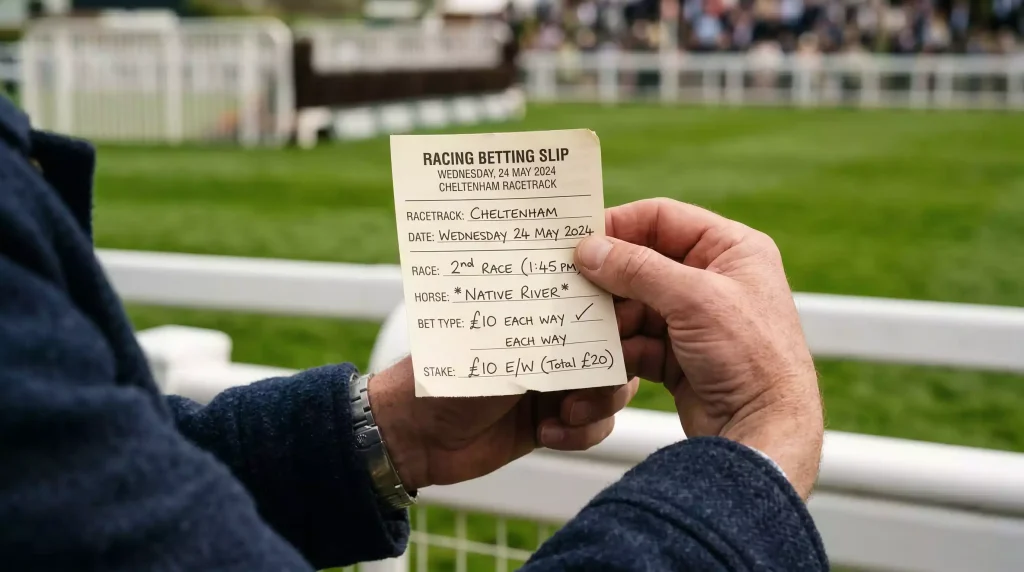
Strip away the jargon and an each-way bet is two separate bets rolled into one. The first part is a win bet — your horse must cross the line first for it to pay. The second part is a place bet — your horse merely needs to finish in one of the designated place positions, and the place portion of your stake returns a fraction of the win odds. Both parts carry equal stakes, which means a £5 each-way bet actually costs you £10: £5 on the win, £5 on the place.
That doubling of the stake is the first thing newcomers trip over, and it is worth repeating because bookmakers are not always brilliant at making it obvious on the bet slip. When you see “£5 each-way” written down, reach for your wallet expecting to part with a tenner.
The Win Part
If your horse wins the race, the win part of your each-way bet pays out at the full advertised odds. A horse at 20/1, backed with a £5 win stake, returns £100 in profit plus your £5 stake back — £105 in total. That much is straightforward and works identically to a standard win-only bet.
The Place Part
The place part is where each-way earns its keep in the Grand National. Your horse does not need to win. It needs to finish in one of the places the bookmaker is paying out on. The payout is calculated at a fraction of the full win odds — typically one-quarter or one-fifth for the Grand National, depending on the bookmaker and the specific promotion they are running.
So if your 20/1 horse finishes fourth in the National and the bookmaker is paying four places at 1/5 odds, your place return is calculated as 20/1 divided by 5, giving you 4/1. On a £5 place stake, that is £20 profit plus your £5 stake — £25 back. You lose the £5 win stake, so your net position is £15 in profit from a £10 total outlay. Not bad for a horse that did not even win.
Why It Suits the Grand National
The Grand National typically features 34 runners tackling 30 fences over four miles and two-and-a-half furlongs. Falls, refusals, and tired horses pulling up are part of the furniture. In a race this volatile, narrowing your hopes to the single winner is a tall order. Each-way opens the door wider. According to Entain’s sportsbook data, 82% of cash bets placed on the 2026 Grand National were £5 or less — your bet in two parts turns a modest stake into a genuine chance of collecting, even if your pick cannot quite lead the field home.
It is also worth noting that the place fraction matters enormously on a race with odds this long. A horse at 33/1 paying one-quarter the odds for a place gives you 33/4 — roughly 8/1 — on the place part alone. That is a meaningful return from a horse finishing, say, third or fourth. On a six-runner handicap at Kempton, the same maths would barely register. The Grand National’s sprawling field is what makes each-way betting feel purpose-built for the occasion.
Grand National Place Terms: Which Bookmakers Pay the Most Places?
Place terms are the single most important variable in each-way betting, and they vary significantly from one bookmaker to the next. Two numbers define your deal: how many finishing positions count as a “place,” and what fraction of the win odds the place part pays. Getting the best terms is not a minor detail — on a 33/1 shot, the difference between 1/4 odds for four places and 1/5 odds for six places can swing your return by tens of pounds on a modest stake.
Standard Grand National Place Terms
The industry standard for the Grand National, and for any handicap with sixteen or more runners, is four places at one-quarter the odds. That means if your horse finishes first, second, third or fourth, the place part of your each-way bet pays out at one-quarter of the full win price. Most high-street and online bookmakers default to these terms for the race.
In practice, however, the Grand National attracts so much betting volume — the Betting and Gaming Council reported around £250 million wagered on the 2026 race — that bookmakers compete aggressively on place terms to win market share. The result is a patchwork of enhanced offers that can materially improve your expected return.
Enhanced Place Offers
In the weeks before the Grand National, it is common to see bookmakers extending their place terms well beyond the standard four. Some pay five places, others six, and a handful have historically stretched to seven or even eight places for the race. The fraction paid also varies: some maintain 1/4 odds on enhanced places, while others drop to 1/5 for the additional positions.
Here is what the landscape typically looks like for the Grand National, based on offers from recent years. Be aware that terms are confirmed closer to race day and can change, so always check the bookmaker’s Grand National page before placing your bet.
| Bookmaker | Typical Places Paid | Place Fraction | Notes |
|---|---|---|---|
| bet365 | 5–6 | 1/5 | Often extends places for ante-post bets placed early |
| William Hill | 5–6 | 1/4 or 1/5 | Frequently runs “Extra Places” promotion for the National |
| Paddy Power | 5–7 | 1/5 | Known for aggressive place term offers on big festivals |
| Betfair Sportsbook | 5–6 | 1/5 | Check Sportsbook vs Exchange — terms differ |
| Ladbrokes | 5–6 | 1/4 or 1/5 | Part of Entain group; terms align with Coral in some years |
| Coral | 5–6 | 1/4 or 1/5 | Check for “1-2-3-4-5-6” Grand National specials |
| Sky Bet | 4–5 | 1/4 | Tends to be slightly less generous on extra places |
| Betfred | 5–6 | 1/5 | Strong retail presence; check in-shop vs online terms |
These are indicative ranges drawn from recent Grand Nationals. The 2026 offers will be announced in March and April, and the smart play is to compare them once they are live rather than assuming last year’s terms will be repeated.
Why Place Terms Matter More Than You Think
Consider a horse at 25/1. At standard terms — four places, 1/4 odds — the place part pays 25/4, which is 6.25/1. On a £5 place stake, that is £31.25 plus your £5 back: £36.25. Now take the same horse under enhanced terms — six places, 1/5 odds. The place fraction drops to 5/1, so the place payout is £25 plus £5: £30. You get slightly less per place, but you have six chances of collecting instead of four. In a 34-runner race where chaos reigns, those extra two finishing positions are worth having.
The arithmetic shifts further when you factor in horses at very long odds. A 50/1 shot at 1/4 the odds pays 12.5/1 on the place. At 1/5 it pays 10/1. The absolute difference per pound staked is larger, but the probability of finishing sixth versus finishing fourth is also meaningfully higher for a longshot. There is a genuine strategic calculation here, and it depends partly on the type of horse you are backing — more on that in the strategies section below.
Each-Way vs Win-Only: Which Is Smarter for the Grand National?
This is the question that divides even experienced punters in the pub on Grand National morning. The win-only camp argues that you are diluting your return by splitting the stake in two. The each-way camp argues that you are insuring yourself in the most unpredictable race on the calendar. Both sides have a point, and the honest answer is that neither approach is universally correct — it depends on the odds, your horse, and your appetite for risk.
The Case for Win-Only
If you fancy a shorter-priced horse — say, the 8/1 favourite or a well-fancied second-favourite at 10/1 — a win-only bet concentrates your entire stake on the higher-paying outcome. The place return on a horse at 8/1 (paying 1/4 the odds) is just 2/1. On a £10 each-way bet costing £20 total, the place part returns £30 — a net profit of £10 on a £20 outlay. That is not terrible, but it is not going to change anyone’s afternoon either. Backing the same horse win-only at £20 returns £160 profit if it obliges. The risk-reward profile is radically different.
Win-only also makes more sense when you have strong conviction. If your analysis of the form, ground, and jockey booking tells you a horse has a genuine winning chance, splitting the stake dilutes the edge you believe you have found. The Grand National is unpredictable, yes, but that does not mean every horse in the field has an equal chance of winning. Form still matters.
The Case for Each-Way
The Grand National’s completion rate paints a vivid picture. In the 2026 running, 21 of the 32 starters finished the race — and that was considered a relatively clean renewal. Falls, unseated riders, and horses pulling up are baked into the race’s DNA. When a third of the field may not see the finishing line, backing a horse each-way buys you margin. Your selection does not need to travel perfectly for four miles; it needs to survive and run into a place.
For longshots — and the Grand National always has them — each-way is where the maths lights up. A horse at 33/1 paying four places at 1/4 the odds returns 33/4 (roughly 8/1) on the place part alone. That means a £5 each-way bet (£10 total) collects £46.25 if the horse finishes in the places without winning. The wide-open nature of the race is precisely what drives the volume. “Due to the open nature of the race and the big-priced odds on offer, we expect huge interest in bets across the country and turnover on the race itself could be over £150 million,” said Lee Phelps of William Hill ahead of the 2026 renewal — and that interest is overwhelmingly channelled through each-way.
A Practical Rule of Thumb
As a rough guide: if you are backing a horse at 12/1 or shorter, consider win-only unless you specifically need the insurance. At those prices, the place return is modest relative to the cost of doubling your stake. For horses at 14/1 and above — which covers most of the Grand National field — each-way becomes progressively more attractive. By the time you reach 25/1 and beyond, each-way is close to a no-brainer for recreational punters, because the place part alone offers a return most people would be pleased with.
And if you genuinely cannot decide, there is nothing wrong with splitting the difference: place a smaller win-only bet and a separate place-only bet at a different bookmaker offering enhanced terms. That requires a bit more legwork, but it gives you granular control over how much exposure you carry on each outcome.
Calculating Your Each-Way Payout: Worked Examples
The maths behind an each-way bet is not complicated, but it does involve a few moving parts, and getting comfortable with the calculation before race day saves you from squinting at a betting slip wondering what you have actually won. Below are three worked examples, each using a different set of odds and place terms, to show how the numbers flow.
Example 1: A Midfield Runner at 20/1 (Standard Terms)
You back Horse A at 20/1, placing a £5 each-way bet. Total outlay: £10 (£5 win, £5 place). The bookmaker is paying four places at 1/4 the odds.
If Horse A wins: The win part pays 20/1 × £5 = £100 profit, plus your £5 stake returned = £105. The place part also pays, because the winner automatically finishes in the places. Place odds: 20 ÷ 4 = 5/1. Place payout: 5/1 × £5 = £25, plus £5 stake = £30. Total return: £105 + £30 = £135. Net profit: £135 − £10 outlay = £125.
If Horse A finishes 2nd, 3rd or 4th: The win part loses (−£5). The place part pays: 5/1 × £5 = £25, plus £5 stake = £30. Total return: £30. Net profit: £30 − £10 outlay = £20.
If Horse A finishes 5th or worse (or does not finish): Both parts lose. Total return: £0. Net loss: £10.
Example 2: A Longshot at 40/1 (Enhanced Terms — Six Places, 1/5 Odds)
You back Horse B at 40/1, placing a £5 each-way bet. Total outlay: £10. The bookmaker is paying six places at 1/5 the odds.
If Horse B wins: Win payout: 40/1 × £5 = £200 + £5 = £205. Place odds: 40 ÷ 5 = 8/1. Place payout: 8/1 × £5 = £40 + £5 = £45. Total return: £250. Net profit: £240.
If Horse B finishes 2nd through 6th: Win part loses (−£5). Place payout: £45. Net profit: £35.
That £35 profit from a £10 bet on a horse that did not win is exactly why each-way appeals so strongly in the Grand National. The place fraction at 8/1 alone is a better return than many people get from their accumulator all season.
Example 3: A Shorter-Priced Contender at 10/1 (Standard Terms)
You back Horse C at 10/1, placing a £10 each-way bet. Total outlay: £20. Four places, 1/4 the odds.
If Horse C wins: Win: 10/1 × £10 = £100 + £10 = £110. Place odds: 10 ÷ 4 = 2.5/1. Place: 2.5/1 × £10 = £25 + £10 = £35. Total return: £145. Net profit: £125.
If Horse C finishes 2nd, 3rd or 4th: Win part loses (−£10). Place: £35. Net profit: £15.
Notice how thin that place profit becomes at shorter odds. A £15 return on a £20 outlay is fine, but it illustrates why each-way on horses below about 12/1 is a lukewarm proposition unless the bookmaker is offering especially generous enhanced terms.
The Dead Heat Complication
Dead heats for a place position are rare in the Grand National but not impossible. If two horses tie for fourth and the bookmaker is paying four places, your place bet is settled at half the normal terms — effectively halving the place return. This applies only to the place position that is shared; it does not affect horses that clearly finished in the other paid positions. Dead heat rules are standard across all UK bookmakers and are stated in their terms and conditions.
Each-Way Strategies That Work for Big-Field Handicaps
Knowing how each-way works is one thing. Using it strategically is another. The Grand National is not an ordinary handicap — it is the most bet-upon race on the planet, it features the largest field of any race most punters will bet on all year, and the range of possible outcomes is enormous. That combination creates specific opportunities for each-way bettors who are prepared to think beyond simply picking a horse they like.
Target the Place, Not the Win
This sounds counterintuitive, but one of the most effective each-way strategies for the Grand National is to select horses whose realistic ceiling is a top-four or top-six finish rather than a win. Horses with solid stamina credentials, a clean jumping record over big fences, and a jockey who rides conservatively in the early stages often run into the places without threatening the leaders. They are not glamorous picks, but the place return at long odds can be extremely rewarding.
The data supports this approach at a basic level. According to a Ladbrokes/Entain survey, 35% of British punters pick their Grand National horse based on the name alone, with fewer than 29% considering form. That is a lot of money flowing into the market without analytical backing — and it creates value for anyone willing to do even a modest amount of homework.
Shop for Place Terms Early
Enhanced place terms are often announced weeks before the race, and some bookmakers offer better terms for ante-post bets placed well in advance. If your selection is a horse you plan to back regardless, locking in six or seven places at 1/5 odds in mid-March may be considerably more valuable than waiting until the morning of the race when the best promotions have been snapped up or the terms tightened.
One practical approach is to open accounts with two or three bookmakers who historically offer the most generous Grand National place terms, fund them modestly, and place your each-way bet with whichever one confirms the best offer. This requires five minutes of preparation and can genuinely shift your expected return.
Use Multiple Each-Way Bets Across Different Horses
Rather than loading all your each-way stakes onto a single selection, consider spreading two or three small each-way bets across horses at different price points. A £3 each-way on a 25/1 shot and a £3 each-way on a 40/1 longshot costs £12 total and gives you two place bets running in a 34-runner race. The probability that at least one of them finishes in the places is meaningfully higher than the probability that either one of them wins. You are playing the numbers — and in a race this large, the numbers favour spread.
Combine Each-Way with Best Odds Guaranteed
If your bookmaker offers Best Odds Guaranteed on the Grand National, your each-way bet benefits from it. Should the Starting Price drift above the price you took, both the win and place parts of your bet are settled at the higher SP. This effectively gives you a free option on price improvement, and it is particularly valuable for ante-post each-way bets where the price at the time of betting may differ substantially from the SP on the day.
Common Each-Way Mistakes and How to Avoid Them
Each-way betting is straightforward in principle, but the Grand National’s unique characteristics create a few traps that catch people out every single year. Forewarned is forearmed.
Forgetting That Each-Way Doubles Your Stake
This bears repeating because it is the single most common source of confusion, especially among first-time punters. A £10 each-way bet costs £20. A £20 each-way costs £40. If you have set yourself a budget of £20 for Grand National day, your each-way stake is £10 each-way, not £20. Bookmaker apps now generally show the total outlay on the bet slip before you confirm, but not all of them make it prominent. Check the total cost before you hit the button.
Not Checking Place Terms Before Betting
Assuming all bookmakers offer the same place terms is a reliable way to leave money on the table. As covered above, terms vary by bookmaker and by the timing of your bet. The difference between four places and six places is not trivial — it means two additional finishing positions where your place stake pays out. Always navigate to the bookmaker’s Grand National each-way terms before placing the bet. If you cannot find them easily, that itself is useful information about the bookmaker.
Backing a Short-Priced Favourite Each-Way
If the Grand National favourite is trading at 6/1, an each-way bet on that horse pays just 1.5/1 on the place part (at 1/4 the odds). On a £5 each-way bet (£10 total), a place-only finish returns £12.50 — a net profit of £2.50. You have risked £10 for a return that would not cover a pint. For short-priced horses in the Grand National, a smaller win-only bet is almost always the more efficient use of your money.
Ignoring the Non-Runner Scenario
If you place an each-way bet ante-post and your horse is withdrawn before the race, you lose your stake unless the bookmaker offers Non-Runner No Bet protection. Some do, some do not, and the terms vary. For each-way bets placed on the morning of the race, Rule 4 deductions may apply if a horse is withdrawn after you have placed your bet but before the off. These deductions are subtracted from your potential winnings and are calculated on a sliding scale based on the withdrawn horse’s odds. Neither scenario is disastrous, but both are worth understanding before the money leaves your account.
Treating Each-Way as a Guaranteed Return
Each-way mitigates risk. It does not eliminate it. Your horse can still fall at the first, refuse at Becher’s Brook, or run so badly that fourth place is a fantasy. In the Grand National, roughly a third of the field typically fails to complete the course. Each-way gives you more ways to win, but it does not make betting risk-free, and anyone who tells you otherwise is trying to sell you something. Set a budget, stick to it, and treat any return as a bonus rather than an expectation. That is the smartest each-way strategy of all.