
Grand National Odds Explained: Fractional, Decimal, Ante-Post and Starting Price
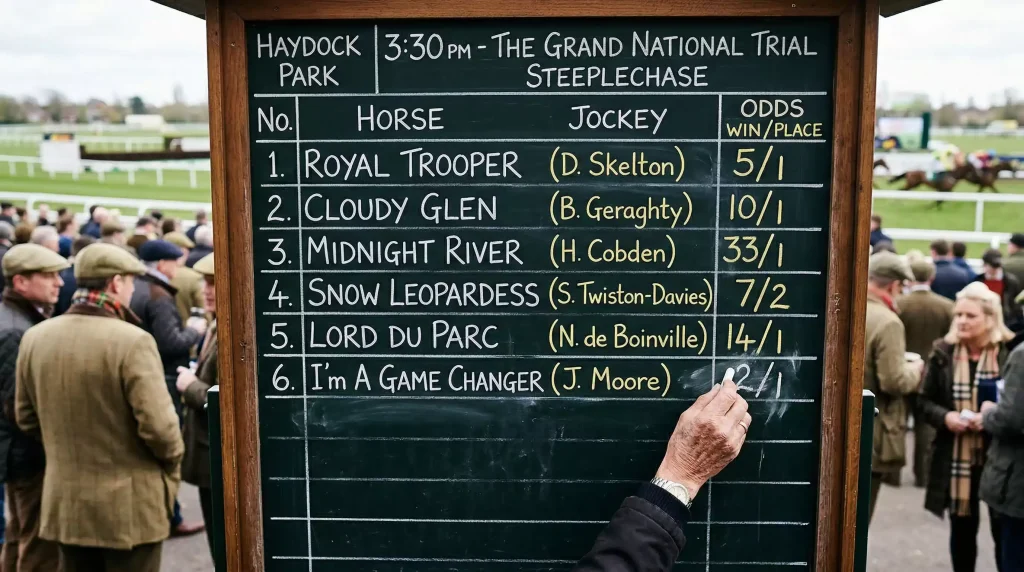
Odds are the language of betting, and like any language, they make perfect sense once you know the grammar and leave you completely lost until you do. The Grand National compounds the confusion because it produces some of the longest prices in mainstream British sport — numbers like 33/1, 50/1, even 100/1 — and presents them in a format that assumes you already understand what those numbers mean. If you have ever stared at a betting board and quietly pretended to know what 11/2 translates to in actual money, this guide is for you.
Understanding Grand National odds is not just an academic exercise. The price attached to each horse is a compressed piece of information: it tells you what the market thinks about that horse’s chance of winning, how much money has been wagered on it, and what you stand to collect if your bet lands. Knowing how to read that information — and, more importantly, when the information is telling you something useful — is one of the few genuine edges available to a recreational punter.
This article covers the two main odds formats used in the UK, how bookmakers arrive at Grand National prices in the first place, the critical difference between ante-post odds and Starting Price, what it means when a horse’s price moves sharply, how Best Odds Guaranteed protects your bet, and what the overall shape of the market can tell you in the final hours before the off. The goal is simple: by the time you reach the end, the numbers on the screen should feel like information rather than decoration.
Fractional vs Decimal Odds: Reading Grand National Prices
British bookmakers traditionally display odds in fractional format — 10/1, 7/2, 5/4 — and the Grand National market is no exception. Most betting sites also offer the option to switch to decimal odds, which are standard in continental Europe and increasingly popular with younger punters who grew up with betting exchanges. Both formats convey the same information; they just package it differently.
Fractional Odds
Fractional odds tell you how much profit you make relative to your stake. The number on the left is the profit, the number on the right is the stake. At 10/1, you make £10 profit for every £1 staked. At 7/2, you make £7 for every £2 staked — or, more usefully, £3.50 for every £1. Your original stake is always returned on top of the profit, so a £5 bet at 10/1 returns £55: £50 profit plus £5 stake.
The tricky ones are the fractions that do not divide neatly. A horse at 11/4 pays £11 for every £4 staked, which works out to £2.75 per pound. A £5 bet returns £18.75 in total (£13.75 profit + £5 stake). If that feels fiddly, it is because fractional odds were designed for mental arithmetic on the racecourse in the days before smartphones. They work brilliantly at clean numbers like 4/1 or 20/1, and they become slightly annoying at 11/8 or 15/8.
Two special cases are worth knowing. “Evens” (sometimes written as 1/1 or EVS) means you double your money — £5 returns £10. “Odds-on” prices, where the first number is smaller than the second (e.g. 4/5, 1/2, 4/6), mean you have to stake more than you stand to win. Odds-on horses are rare in the Grand National — the favourite almost never trades shorter than 5/1 — but they crop up in shorter races throughout the Aintree Festival.
Decimal Odds
Decimal odds express your total return per pound staked, including the stake itself. A horse at 11.0 in decimal is the same as 10/1 in fractional — a £1 bet returns £11 total. A horse at 4.50 is 7/2 — £4.50 back per pound staked. To calculate profit, subtract 1 from the decimal price: 11.0 − 1 = £10 profit per pound.
The advantage of decimal odds is that the maths is easier when comparing prices across different horses. If Horse A is 21.0 and Horse B is 17.0, you can instantly see which pays more without converting fractions in your head. The disadvantage is cultural — fractional odds are deeply embedded in British racing, and commentators, tipsters and pub conversations still default to phrases like “backed at tens” or “a seven-to-two shot.” If you are betting on the Grand National in the UK, you will encounter fractional odds everywhere, so it is worth being comfortable with both formats.
Converting Between Formats
The conversion is simple. To go from fractional to decimal: divide the left number by the right number, then add 1. So 20/1 becomes (20 ÷ 1) + 1 = 21.0. And 7/2 becomes (7 ÷ 2) + 1 = 4.5. To go from decimal to fractional: subtract 1, then express the result as a fraction. 9.0 becomes 8/1. 3.5 becomes 5/2. Most bookmaker apps and websites handle this automatically — you set your preferred format in your account settings and every price on the site adjusts accordingly.
Implied Probability
Both formats can be converted into an implied probability, which tells you the market’s assessment of a horse’s chance of winning, expressed as a percentage. The formula for fractional odds is: right number ÷ (left number + right number) × 100. So 10/1 implies a 9.1% chance. 4/1 implies 20%. 33/1 implies about 2.9%. For decimal odds, divide 1 by the decimal price and multiply by 100: 1 ÷ 11.0 × 100 = 9.1%.
In a perfectly efficient market, the implied probabilities of all runners would add up to 100%. In practice, they add up to more than that — typically 110% to 130% for the Grand National — because bookmakers build a profit margin into the prices. This margin, known as the overround, is explored in detail in the section on how bookmakers set odds below.
How Bookmakers Set Grand National Odds
Grand National odds do not appear from thin air. They are the output of a process that blends data, judgement and market dynamics — and the process starts much earlier than most punters realise.
The Initial Tissue Price
Months before the race, bookmakers’ trading teams build what is known as a tissue — an initial set of prices based on each horse’s form, rating, weight allocation, and historical performance over fences. The tissue is essentially the bookmaker’s first draft of the market, and it draws on the same data any serious form student would use: Racing Post ratings, official BHA handicap marks, course form at Aintree, distance form over four miles or further, and the record of the trainer and jockey combination.
At this stage, the prices are wide and approximate. A horse that has won a decent three-mile chase might open at 33/1 in the ante-post market, reflecting both its quality and the enormous uncertainty involved in predicting a race that is still months away. The tissue prices are deliberately conservative — bookmakers want to attract bets without exposing themselves to excessive liability on any single runner.
Market Forces Take Over
Once the ante-post market opens, something interesting happens: the public starts betting, and the prices respond. A horse that attracts heavy support will see its odds shorten — from 33/1 to 25/1 to 20/1 — as the bookmaker adjusts to balance its book. A horse that nobody wants to back will drift outwards. This is a continuous process that runs from the moment the ante-post market opens until the final seconds before the off.
The Grand National’s scale makes this dynamic particularly intense. According to Entain’s global sportsbook data, the Grand National generated 700% more bets than the Cheltenham Gold Cup in 2026 — the sheer volume of money flowing into the market means that the odds are constantly under pressure, and the bookmaker’s trading team is adjusting prices in real time to manage risk.
The Overround
Bookmakers are not charities. They build a profit margin into the odds by ensuring the combined implied probabilities of all runners add up to more than 100%. In a theoretical fair market, a 34-runner race would have probabilities summing to exactly 100%. In a real Grand National market, the overround typically sits between 115% and 130%, depending on the bookmaker and how competitive they are choosing to be.
This means that, on average, the odds offered are slightly less generous than the “true” probability of each outcome. The overround is the bookmaker’s edge, and it is baked into every price you see. Competitive bookmakers keep their overround lower, offering better value to the punter. Less competitive ones push it higher. Comparing overrounds across bookmakers is one way to find the best-value market — though for a once-a-year punt, the difference is usually marginal enough that convenience matters more than chasing the absolute lowest overround.
The Influence of Other Bookmakers and Exchanges
No bookmaker sets prices in isolation. They monitor each other’s markets and, critically, the betting exchanges — platforms like Betfair where the odds are set by punters rather than traders. If a horse is trading significantly shorter on Betfair than in the bookmaker’s own market, the bookmaker will typically cut its price to avoid being arbitraged. The exchanges act as a reference price for the entire market, and their influence is strongest in the final hours before the race when liquidity is highest.
Ante-Post vs Starting Price: When Should You Back Your Horse?
One of the biggest decisions in Grand National betting is not which horse to back, but when to back it. The price you take weeks before the race can be dramatically different from the price available at the off, and understanding the trade-offs between ante-post odds and Starting Price is essential if you want to get the most from your wager.
What Ante-Post Means
Ante-post betting refers to any bet placed before the final declarations stage — in practice, any bet placed more than a couple of days before the race. Ante-post odds are typically longer than race-day odds, because they carry additional risk: if your horse is withdrawn before the race, you lose your stake. There is no refund on a standard ante-post bet, which is why the prices are more generous — you are being compensated for the risk that the horse might not run.
The 2026 Grand National offered a perfect illustration. Nick Rockett, who went on to win at 33/1, was available at considerably longer prices in the ante-post market during the winter months. Punters who backed him early locked in a bigger number; those who waited until closer to the race found the price had shortened as the market caught up to his improving form and the Mullins stable’s growing confidence. That kind of price movement is typical for the Grand National, where the ante-post market can move significantly between January and April as trial races are run, injuries occur, and trainer intentions become clearer.
What Starting Price Means
The Starting Price is the official price of a horse at the moment the race begins, determined by the on-course market. If you bet at SP, your return is calculated at whatever the Starting Price turns out to be. Some punters choose SP deliberately — either because they believe the horse will drift to a bigger price by race day, or simply because they prefer not to lock in a number early.
SP also applies by default if you place a bet in a betting shop without specifying a price, or if you take a price and the bookmaker’s terms state that SP applies (this is uncommon for online bets but standard for certain promotions).
The Trade-Off
Ante-post gives you bigger prices but no protection against non-runners. SP gives you the market’s final assessment but often at shorter odds. The right choice depends on your situation.
If you have strong conviction about a horse early in the season — perhaps based on trial form, a trainer’s public comments, or course-and-distance credentials — taking the ante-post price makes sense. You are accepting the risk that the horse might not run in exchange for odds that may never be available again. If the horse was 40/1 in January and is 20/1 on race morning, you are sitting on double the potential return.
If you prefer to wait until the declarations are confirmed and the going is known, betting on the day at the available price removes the non-runner risk. You will pay for that security with shorter odds, but you are betting with fuller information. “The Grand National and the Super Bowl are cultural phenomena that transcend sports and are annual traditions for recreational customers,” noted Greg Ferris, Managing Director of Sports at Entain. For those recreational customers — the once-a-year punters who make up the bulk of the market — betting on the day is the natural approach, and there is absolutely nothing wrong with it.
Non-Runner No Bet: A Middle Ground
Some bookmakers offer Non-Runner No Bet (NRNB) on the Grand National, which refunds your stake if your selection does not run. This effectively removes the main downside of ante-post betting. NRNB prices are usually slightly shorter than standard ante-post prices — the bookmaker is offering insurance, and insurance has a cost — but they can represent excellent value for punters who want the benefit of early odds without the withdrawal risk. Check whether NRNB is available, and factor its slightly tighter prices into your decision.
Market Movers and Drifters: What Odds Movements Tell You
Once you understand what the price is, the next question is what the price is doing. Odds do not sit still. They move — sometimes gradually over weeks, sometimes violently in the final hour before the race — and those movements contain information that is worth paying attention to, even if you are not a professional trader.
What Is a Market Mover?
A market mover is a horse whose odds are shortening, meaning money is coming in for it. If a horse opens at 25/1 on Monday and is 16/1 by Saturday morning, it has been “well-backed” or “supported.” The reasons can vary: a strong piece of trial form, stable confidence leaking into the market through professional punters, a favourable draw or going change, or simply a prominent tipster recommendation that triggers a wave of public money.
In the Grand National, where the field is large and the betting volume colossal, market moves tend to be more meaningful than in smaller races. It takes a substantial amount of money to shift a horse’s price from 25/1 to 16/1 in a market this deep, so a move of that magnitude usually reflects genuine confidence rather than a few speculative punts.
What Is a Drifter?
A drifter is the opposite: a horse whose odds are lengthening because the market is not interested. If a horse was 12/1 on Monday and is 20/1 by Saturday, it has drifted. Drifters can be concerning — the market may know something you do not, such as an unannounced fitness concern or a trainer’s private doubts. But they can also represent value, if the reason for the drift is benign (for example, a well-fancied rival being supplemented into the race, which dilutes the pool of money across more runners).
The important thing is to ask why a horse has drifted before assuming it is bad news. Check the racing press, listen to trainer quotes in the previews, and look at whether the drift is specific to one horse or part of a broader market reshuffle. In the Grand National, market-wide recalibration is common in the days after final declarations, when the confirmed field forces bookmakers to redistribute their probabilities.
When Moves Happen
Grand National odds move at several predictable points. The first is when the initial ante-post market opens, usually in the autumn. Prices shift as trial races produce results through the winter — a strong run at Haydock or Cheltenham can cut a horse’s Grand National price overnight. The second major shift comes at the five-day declaration stage, when the field is confirmed and non-runners are announced. The third and sharpest movements occur on race day itself, particularly in the final thirty minutes before the off, when the on-course market opens and the volume of bets reaches its peak.
For recreational punters, the practical lesson is straightforward: if you are betting on the day, check the price just before you place your bet, not an hour before. Markets move fastest in the final countdown, and the price you saw at breakfast may not be the price available at 5pm.
Best Odds Guaranteed: How It Works and Which Bookmakers Offer It
Best Odds Guaranteed — usually abbreviated to BOG — is one of the most valuable promotions in horse racing, and it is especially useful on the Grand National, where the gap between ante-post prices and Starting Price can be significant.
The Mechanics
BOG is simple in concept. If you take a price on a horse — say 20/1 — and the Starting Price is higher — say 25/1 — the bookmaker settles your bet at the higher price. You get 25/1 without having had to wait for the SP. If the Starting Price is lower than the price you took, your bet is settled at your original price. In other words, you always get the best of the two: the price you took or the SP, whichever is greater.
This applies to both the win and place parts of an each-way bet. If your horse finishes in the places and the SP was higher than your early price, the place payout is also calculated at the enhanced SP fraction. The benefit can be substantial on the Grand National, where outsiders sometimes drift from 25/1 to 33/1 or from 40/1 to 50/1 in the final minutes before the off.
Which Bookmakers Offer BOG on the Grand National?
Most major UK bookmakers offer BOG on domestic horse racing as standard, but the terms are not identical. Some offer BOG on all horse racing bets placed from early morning on the day of the race. Others extend it to bets placed the evening before. A few offer BOG on selected ante-post bets placed weeks in advance, though this is less common and usually attached to specific promotional campaigns.
The bookmakers most consistently associated with BOG across recent Grand Nationals include bet365, Paddy Power, William Hill, Betfair Sportsbook, Coral and Ladbrokes. Sky Bet and Betfred also typically offer it, though the time window can vary. Always confirm BOG availability and terms before placing your bet — the promotion is often stated on the race page or in the bookmaker’s promotions tab.
When BOG Matters Most
BOG is most valuable when you take an early price on a horse that subsequently drifts. This can happen for perfectly innocent reasons: perhaps a more fancied rival is declared, diluting the market, or the going changes to conditions your horse is known to prefer, causing others to flood in and push certain prices out. In those scenarios, BOG gives you a free ride on the price improvement. You locked in your selection early, and you benefit from the late market movement without having had to predict it.
For the Grand National specifically, where the sheer number of runners creates constant price fluctuations in the final hours, BOG acts as a standing insurance policy that rewards early decision-making. It removes one of the main arguments for waiting until the last moment to bet: the fear of missing a better price.
Reading the Grand National Market: Signals Before the Off
The Grand National market is not just a collection of individual prices. It is an ecosystem, and reading its overall shape can tell you things that no single horse’s odds can reveal on their own.
The Top of the Market
Start with the favourite. In most Grand Nationals, the favourite trades between 5/1 and 10/1 — considerably longer than the favourite in a typical flat handicap. That wide price reflects the genuine difficulty of winning a race over four miles and thirty fences with 34 runners. When the favourite is unusually short — say, 4/1 or shorter — it usually indicates a horse of exceptional quality entering the race, or a field perceived to be weaker than average. When the favourite is 10/1 or longer, it signals a genuinely open contest where the market cannot separate the leading contenders.
The spread between the favourite and the second favourite is also informative. A narrow spread — 6/1 favourite, 7/1 second favourite — suggests a competitive top end. A wide spread — 5/1 favourite, 14/1 second favourite — suggests one horse stands clearly above the rest in the market’s estimation.
The Middle of the Market
The cluster of horses between 14/1 and 25/1 is often where the most interesting Grand National betting takes place. These are runners with identifiable form and realistic chances but enough doubt to keep their odds in double figures. Movements in this band are particularly significant on the morning of the race, because this is the zone where informed money — from professional punters, stable connections and shrewd observers — tends to concentrate. A horse that moves from 20/1 to 14/1 on race morning, without an obvious tipster catalyst, is worth investigating.
The Tail of the Market
Horses at 40/1 and beyond are the lottery tickets. They are priced long for a reason, and the vast majority of them will not win. But the Grand National’s unique demands — extreme distance, massive fences, attritional pace — create conditions where longshots survive more often than in any other race. The 2026 winner, Nick Rockett, returned 33/1 — far from a favourite but not the most outlandish price in the field either.
The Grand National’s status as the world’s most bet-upon horse race ensures the market has extraordinary depth. Entain’s data confirmed it as the number-one global sporting event by number of bets in 2026, ahead of the Super Bowl and US Masters. That volume draws money from casual and professional punters alike, with an estimated audience of around 600 million viewers across 140 countries. The result is a market that is both highly liquid and highly scrutinised — which means that when the price tells you something, it is usually worth listening.
What the Price Really Tells You
Odds are not predictions. They are the market’s aggregated opinion, filtered through bookmaker margins and shaped by the weight of money. A 10/1 shot is not ten times less likely to win than the favourite — it is priced at 10/1 because that is the point where the bookmaker’s liability is balanced given the bets already placed. The distinction matters, because it means the odds can be wrong. Horses at 10/1 sometimes should be 6/1. Horses at 25/1 sometimes should be 40/1. Spotting those discrepancies — finding what the price really tells you versus what it should tell you — is, in essence, what the entire craft of betting is about.